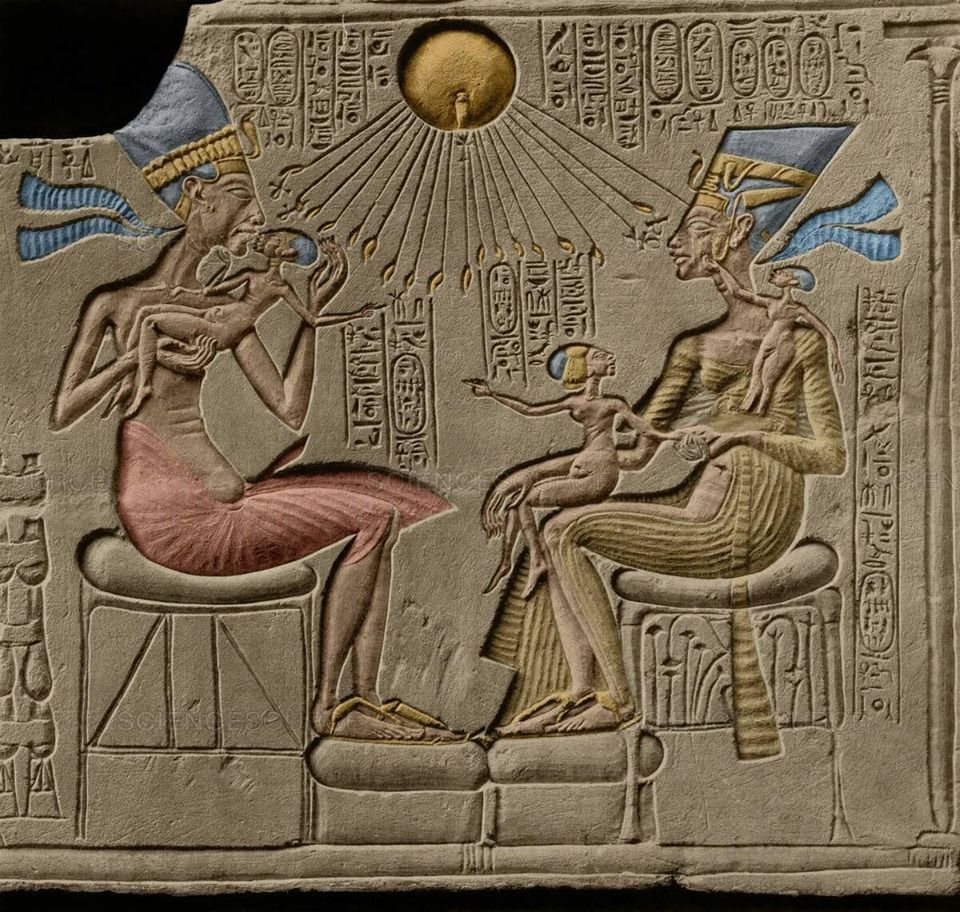
Image credit: Sunk-relief depicting Egyptian pharaoh Akhenaton, his wife Nefertiti, and three of their daughters, with the sun god Aton, 14th century BCE
part 7 of a series
As old as time itself
Editors’ note: The Egyptian hieroglyphic script, hieroglyphikos (ἱερογλυφικός), meaning “sacred carving,” is an abjad, a writing system lacking vowels. Thus, it is left to the reader to add the vowels by means of inference. For those hailing from the American Midwest, this presents a particular difficulty, as nearly all vowels are reduced to the quality of a schwa (ə), pronounced eh. (For further on this, see For want of a vowel: part 1.) This explains why, in the present context, different vowels are used to name the same entity. The new god introduced in this essay may be spelled Aton or Aten, as can the king who invented (or discovered) the god, Akhenaton or Akhenaten. The older god, temporarily displaced by the more recent, may be Amon or Amun. The author assures us that a vigorous attempt has been made to systematize spelling variations present in the sources consulted; we find said efforts decidedly mixed. Our sincere apologies for any ensuing confusion.
For as each sect is positive that its own faith and worship are entirely acceptable to the deity, and as no one can conceive, that the same being should be pleased with different and opposite rites and principles; the several sects fall naturally into animosity, and mutually discharge on each other that sacred zeal and rancour, the most furious and implacable of all human passions.
– David Hume, The Natural History of Religion
As your sort are obsessed with stories, preferring them to facts, here’s one.
There was once a king. Because all good stories need a king, right? Or a prince and a damsel, pretty much the same, king implied if not stated. Could it be the English king? Lord, save us from that, Dieu et mon droit and all, which inexplicably goes on to this day. Although, what kings have ruled without their god and their own right? A Hebrew king? Pretty much the same, though occasionally the prophets pushed back, preferring to be in power themselves in a theocracy mandated by the same divinity who from time to time favored kings. Or not. And so it goes.
The Greeks had their kings as well, but they were never entirely comfortable with them. In early times (the Mycenaean Age), the king was called the wanax and ruled supreme from his palace. There were about 10 major palace complexes, until one by one they burned for reasons still a puzzle, known as the Bronze Age Collapse, ultimately leading to a new saeculum named for iron. The wanaxes didn’t suffer their fate alone. The Hittite Empire also fell, and other empires (the Assyrian Empire in Mesopotamia, the Egyptian New Kingdom) survived, but wounded. A fission of mysterious cause, inaugurating a saeculum not named for its metals, but for its mood: the Dark Ages.
By the time of Homer the top spot was called the basileus, more of a warlord and judge (think Agamemnon) with limited powers and subject to criticism by inferiors. A little later in the Archaic period, aristocratic councils were more the norm, the king now known as the archon basileus. Which is funny because that sorta means “king king” but, despite the emphatic redundancy, the role had dwindled to ceremonial functions. Ribbon cuttings and so on.
In the Classical period, despotism, epitomized in the Persian king, was the thing most to be avoided. Asians were thought to be slaves by nature, needing the heavy hand of despots, which was fine because that was just the way they were. What was not fine was any similar arrangement for freedom-loving Greeks, not at all slavish by nature. Despotism, legitimate for Asians, was for Greeks tyranny, illegitimate rule over the unwilling. So says Aristotle.
If a king was to be had, better a stonemason than an aristocrat. Which is what Socrates was (and a busy body to boot, also ugly), asking Athenians irritating questions while they were just trying to get on with things. Achilles, one of the minor warlords back in Archaic times, was also irritating (but not at all ugly and the son of a goddess), mostly to basileus Agamemnon, who found the hero so insufferable that he stole Achilles’s girlfriend. No fans of Agamemnon, Athenians of the Classical period loved their hero Achilles. He was everything you want to be: semi-divine, beautiful and (after a period of pouting to piss Agamemnon off good and proper) lethal—the best of the Achaeans. Nay nay, Plato lectured the Athenians, that’s no model. Better a philosopher-king, even if not of the aristocratic variety and an ugly busy body.
Everybody knows how that bit of unasked-for advice turned out.`
But this story is of a proper king, the King of the Nile, Amonhotep IV. A king with a crazy idea. The name Amonhotep (jmn-ḥtp, in ancient Egyptian) means “Amon is satisfied.” Happy god, happy life. But the fourth king so named was not the least bit satisfied with the mess Egyptians had made of their gods. Who was top dog? For a while it was Horus, then Re, then Amun or Amun-Re, then Ptah…. You can almost hear jmn-ḥt IV saying, Really?
jmn-ḥt IV didn’t rule for long, less than 20 years in the fourteenth century BCE, but he got a lot done. Early in his reign he is shown worshipping the traditional Egyptian gods, but with a subtle shift, as the falcon-headed god Re-Harakhte was given a special epithet, “he who rejoices in his horizon, in his aspect of the light which is in the sun’s disk.” A little strange that, but so far so good. Except, that was just the start. Amenhotep IV founded several new temples to Re-Harakhte and, worse, gave him an even more outrageous epithet: “the light which is in the sun’s disc (aten).” And there you have it, a new god, Aten, borne from the head of one person, like Athena—that Q before anyone had a letter for it—springing out of the head of Zeus. jmn-ḥt IV was so smitten by his crazy idea that, in the fifth year of his reign, he changed his name to Akhenaten, (ꜣḫ-n-jtn, from ꜣḫ, “effective” + n “for” + jtn “sun-disc, Aten”), meaning “Effective for the Aten.”
Effective is an understatement. ꜣḫ-n-jtn (Akhenaten) defrocked Thebes as the capital city and founded a new one 300 miles north, which he named Akhetaten, meaning “Horizon of the Aten.” But he was not satisfied with that. He banned the worship of other gods, which was not nice, as that included public festivals for the masses. Days off lost. Meaner still, he declared that he alone could worship Aten, and that worship previously directed toward the traditional gods be directed toward himself. Pretty chesty.
And then there’s the issue of the temples he built for Aten. Traditional Egyptian rituals were performed in small, dark sanctuaries, not unlike the Holy of Holies in Solomon’s temple. Which might lead you to wonder how Solomon got the idea; Canaan had been, after all, an Egyptian territory for over three centuries…. Akhenaten’s rituals honoring his new god were conducted in broad daylight, for heaven’s sake! The Aten temples at Karnak had vast, open-air courts with almost no interior spaces at all.
Perhaps most innovative (or disturbing) was the depiction of the god himself. No longer the familiar anthropo- or theriomorphic gods: falcon-headed Horus, Amun with his plummed headdress, leonine Sehkmet. Aten, above all such childishness, was portrayed as the sun’s disk, with rays extending down to grace the royal family, each ray having a tiny hand, sometimes caressing the crowns and limbs of the royal couple.
Scholars quibble, as they are wont to do, over whether the Akhenaten’s new religion was the first true monotheism, or something more like a primes inter pares situation. The Great Hymn to Aten, perhaps composed by ꜣḫ-n-jtn himself, would seem to indicate something closer to the former. James Henry Breasted, founder of the esteemed Oriental Institute at the University of Chicago, had no doubts. In his PhD dissertation, De hymnis in Solem sub rege Amenophide IV conceptis (Berlin, 1894), he wrote, “Not a rag of superstition or of falsity can be found clinging to this new worship evolved out of the old Aten of Heliopolis, the sole Lord of the universe.”
The Great Hymn, whose themes many find curiously echoed in Psalm 104, reads in part:
Men had slept like the dead; now they lift their arms in praise, birds fly, fish leap, plants bloom, and work begins. Aten creates the son in the mother’s womb, the seed in men, and has generated all life. He has distinguished the races, their natures, tongues, and skins, and fulfills the needs of all. Anton made the Nile in Egypt and rain, like a heavenly Nile, in foreign countries. He was a million forms according to the time of day and from where he is seen; yet he is always the same.
Toward the end of Akhenaten’s short reign, a plague descended upon Egypt, as plagues always descend from on high. Ditto other catastrophes, like 911, recognized by some high priests to be divine judgement for the abomination of homosexuality, lesser priests in their temples and madrassas endorsing that view. The king’s three daughters succumbed, as may have the king himself—no account of his death is preserved. But Akhenaten knew it was coming. A boundary stela marking the new capital’s borders reads, “Let a tomb be made for me in the eastern mountain [of Akhetaten]. Let my burial be made in it, in the millions of jubilees which the Aten, my father, decreed for me.”
Following his death, a succession of pharaohs ruled, each with extremely brief tenures, until things stabilized for a bit under Pharaoh Tutankhamun, whose name means “living image of the Amun.” But, as it turns out, he was not given that name at birth, but rather Tutankhaten, meaning “living image of the Aten.” It’s generally thought that the pharaoh known today as King Tut was the son of Akhenaten, which would make sense of the birth name. But why the change? Aten was the god his father had dreamed up, Amun was the traditional Egyptian creator god, the patron of the old capital of Thebes.
Tutankhamun is most famous for his restoration of traditional Egyptian polytheism. Under his rule, everything old was new again. And just in time, because things had gotten out of hand, cosmically so:
Now when His Majesty was crowned King the temples and the estates of the gods and goddesses from Elephantine as far as the marshes of Delta had fallen into ruin. Their shrines had fallen down, turned into piles of rubble and overgrown with weeds. Their sanctuaries were as if they had never existed at all. Their temples had become footpaths. The world was in chaos and the gods had turned their backs on this land. If an army was sent to Djahy to extend the boundaries of Egypt, it would have no success. If you asked a god for advice, he would not attend; and if one spoke to a goddess likewise she would not attend. Hearts were faint in bodies because everything that had been, was destroyed.
That from the famous Restoration Stele of Tutankhamun, discovered in 1905 by the French Egyptologist Georges Legrain. Hard to believe, though, as when Tut took the throne he was only eight or nine years old and changed his name two years into his reign. The old guard must have been biding their time, waiting for the opportunity to reassert their sacral authority, finding an opportunity in the young pharaoh. A story as old as time itself.
And reassert they did. Successive pharaohs took pains to disappear the very memory of Akhenaten. Under Pharaoh Horemheb, Egyptians began to destroy Aten temples. Seti I ordered Akhenaten’s name and those of other rulers of the hated “Amara period”—including Tutankhamun—to be eliminated from official lists of pharaohs. The revised tally skipped straight from Amonhotep III (Akhenaten’s father) to Horemheb. Not to be outdone, Ramessides destroyed the new capital, using its stones in various building projects across Egypt. In the 13th century, about a hundred years after ꜣḫ-n-jtn, a certain person, Mose by name, a scribe of the treasury of Ptah (Ptah being another of the old Egyptian creator gods), was buried in a tomb with an inscription describing Akhenaten’s reign as “the time of the enemy of Akhet-Aten.”
The erasure of ꜣḫ-n-jtn’s memory was so thoroughgoing that he remained lost to history until the discovery of his new capital on the site known today as Amarna by the Deutsche Orientgesellschaft, a scholarly gift from the Germans in the years before the nasty business of the World Wars (but not before the nasty business of Nietzsche).
The Egyptians finally got back to their former routine, worshipping many anthropomorphic gods rather than a single abstracted one, but it wasn’t the same. Some scholars think the role of the pharaoh as god’s representative on earth was fatally wounded. In their telling, worship of the old gods by the people became more direct and personal, the gods intervening directly in their lives, pharaohs being unnecessary. The former ancient-of-days, Amun, was restored to his rightful place at the top of the divine hierarchy. The Dutch Egyptologist Jacobus Van Dijk summed it up: “the king was no longer a god, but god himself had become king.” By the 11th century, the High Priests of Amun—a priestly class outlawed by Akhenaten—owned two-thirds of all the temple lands in Egypt, 90 percent of Egyptian ships, and a whole lot more. With more power than the pharaoh, the old guard had its revenge. For a time.
Alexander the Great conquered Egypt in 332 BCE without so much as firing a shot. The priests of Amun, recognizing in Alexander’s previous military successes the hand of god, greeted Alexander at Memphis’s city gates. The oracle of Amun-Ra pronounced him a son of Amun, syncretized to Zeus-Ammon, Alexander wearing the Egyptian god’s ram horns on the most expensive coins minted. So began Egypt’s Ptolemaic period, officially founded in 305 BCE by Alexander’s general Ptolemy I Soter—”Savior,” an epithet pressed into global service in centuries to come.
It was in Ptolemaic times that the cult of Isis, an ancient Egyptian goddess, grew in importance, finally eclipsing even Amun. An Egyptian hymn to Isis, written in Greek, describes her as “the beautiful essence of all the gods.” Her brother-husband, Osiris, was murdered and dismembered by his brother Set. The usual throne-envy in play. Isis, shattered by Osiris’s murder, searched for his body parts with her brother Nephthys and other deities. Some versions of the tale have the parts discovered in a patch of reeds, others have them scattered over the whole of Egypt. Whichever, Isis put them back together again and resurrected Osiris by means of a spell, lasting just long enough to have biblical relations, producing the god Horus.
Some Egyptologists speculate that the Osiris myth may have been based on an actual person, maybe a shepherd, as Osiris is so often depicted with a crook and flail. However that may be, the worship of Isis and Osiris dates back to at least the 25th century BCE, long before the cult spread across the Mediterranean, ultimately incorporated in Roman religion. When another good shepherd from the orient is said to have been murdered and then resurrected by a deity. A story as old as time itself, the dying and rising god.
Homo nosce te ipsum are, besides being story tellers, compulsive cataloguers. Due, no doubt, to the chore YHWH gave Adam in that long-lost Garden. They’ll catalogue Hebrew lineages, Achaean ships, plants, butterflies, the stars in the sky. They’ll even catalogue time, a succession of ages.
Among the time-obsessed is a whole lineage of historians and sociologists who attempt to find order in the chaos of history. Spengler, Toynbee, Weber, Jaspers…. One question in particular nags: How did Homo nosce te ipsum move from stories to theories? How did anyone ever think to ask, “Is this story true?” in a time when, as Robert Bellah puts it, “believers in one myth have no need to find the myths of others false.”
In sum, how to account for the shift from mores to morality?
The cataloguers construct theories to tell the story, with Akhenaten often a central figure, the harbinger.
The monotheistic revolution of Akhenaten was not only the first but also the most radical and violent eruption of a counter-religion in the history of mankind. The temples were closed, the images of the gods were destroyed, their names erased, and their cults discontinued. What a terrible shock such an experience must have dealt to a mentality that sees a very close interdependence between culture and nature, and social and individual prosperity! The nonobservance of ritual interrupts the maintenance of cosmic and social order. (Jan Assman, Moses the Egyptian: The Memory of Egypt in Western Monotheism.)