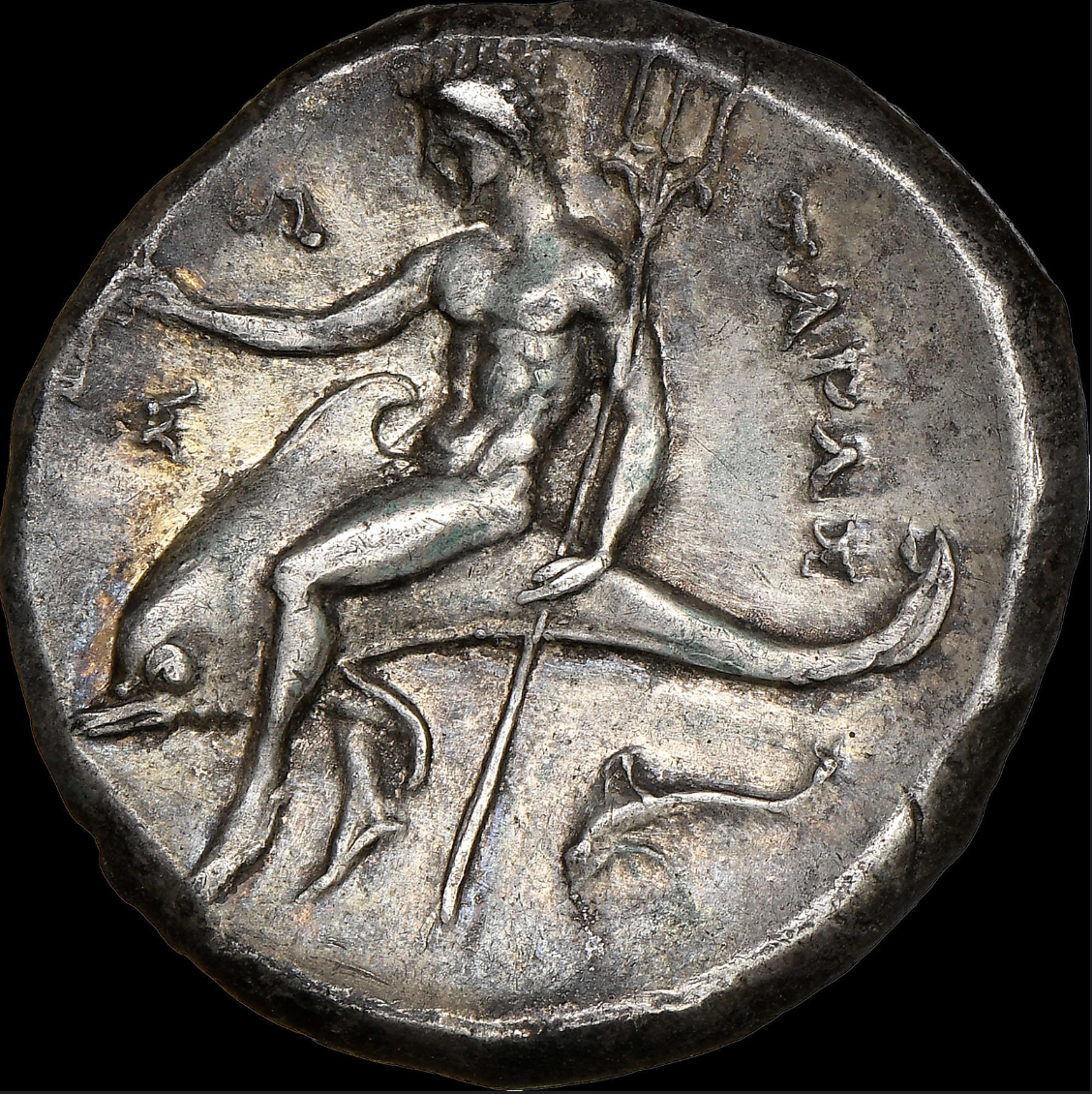
Image credit: Taras saved by a dolphin, Calabria – AR Didrachm [332-302 BC] – Paramount Collection
part 5 of a series
Of which you are a small part
Highest of the gods, lord of the sea, Poseidon of the golden trident, earth-shaker in the swelling brine, around you the finny monsters in a ring swim and dance, with nimble movements of their feet leaping lightly, snub-nosed hounds with bristling neck, swift runners, music-loving dolphins, sea-nurslings of the Nereïd maids divine, whom Amphitrite bore, even they that carried me, a wanderer on the Sicilian main, to the headland of Taenarum in Pelops’ land, mounting me upon their humped backs as they clove the furrow of Nereus’ plain, a path untrodden, when deceitful men had cast me from their Sea-faring hollow-ship into the purple swell of ocean.
– Arion, “Hymn to Poseidon,” quoted in Aelian, On the Nature of Animals, Book 12.45
It requires noting that the Ancient Greeks spent more time guessing about physics than biology. They could imagine atoms, but not cells. Why? No idea. But when one of them wanted to distinguish humans from other species, he came up with the label ζῷον πoλιτικόν (zōon politikon), which translates to “animal of the polis.” That would be Aristotle in Politics. Sure, his argument goes, other animals can form groups, but only humans have the capacity for reason [“capacity” doing a lot of work there] and the ability to organize into moral communities.
The Stoics rejected all talk of atoms, were more interested in the cosmopolis than the polis, and didn’t know about cells either, not having fine enough mirrors to discover them, even if they cared to. So when they wanted to talk about humans as a group, they sometimes resorted to thinking of it as a body with its different parts: hands, feet, eyes, what have you, all meant to work together. St. Paul did as well.
Except, the Stoics were somewhat nicer in their view of Homo nosce te ipsum than the heirs of the Abrahamic tradition were—and are. The Stoics invented the word “cosmopolis,” arguing that all of humanity were common members of a higher city, not a chosen Volk.
How different might history be, you muse, if Constantine hadn’t converted.
But you do know about cells and, in a way could, if you cared to, think of yourself as one cell, wrapped in the baggie that is your skin, among other cells similarly encased, together comprising Homo nosce te ipsum. The One of which you are a small part. Your species.
You also know, thanks to the Prince of Botany, that your species is part of the Regnum Animale, right alongside Simia (apes and monkeys), Lemur (lemurs, colugos) and Vespertilio (bats, all sorts). Except that, as more has been learned with the aid of ever better mirrors, things once known have changed. It is now known—which is good enough for you to claim you know—that your closest relatives are chimpanzees and bonobos. And that, no, you did not descend from either of them, but you share an inferred common ancestor. Inferred because nobody has actually found a trace of it, which could be due to the conjecture that they existed so long ago, about six million years, maybe more, the time when your sort and their sorts are thought to have parted company. Or maybe it’s just bad archaeological luck. However that may be, the alleged ancestor lacks a name, having not been given one by Carl. Why? Because only actual specimens get names. Even Adam wasn’t asked by YHWH to name imaginary animals, for heaven’s sake.
But when it comes to inferred facts, needs must. You have got to call the thing that is only imagined to exist something if you’re going to discuss it, or argue about it, which is what academics spend their time doing. Your imagined ancestor is in a similar predicament to the inferred common source used in part by Sts. Matthew and Luke to compose their gospels, but not found in St. Mark’s version. Its name is Q, for the German Quelle, which means … “source.” Clever as German academics are in their various dark arts, they’re not great at naming.
That might explain, you think, in an incandescent burst of insight, why BMWs have numbers instead of names.
And then, Lord, is it that bad?
Followed by, SHUT UP!
Worse still, American New Testament scholars, even less educated than their German counterparts, tend to call Q the “Q source.” Which tells you how much German they might know. Or how much they care. Which might also tell you why American automobile manufacturers actually name a lot of their cars (unless they’re trying to be cool by imitating Germans, Teutonic engineering thought to be better, opting for alphanumeric, like the Ford F150). Which sometimes they make a mess of. Chevy’s Nova, very popular in the 70s, was sold into the Mexican market with the same name, Nova. With a plate on the foot step reading “Body by Fisher.” Not good on two counts: No va in Spanish means “doesn’t go.” And the word they used for “body,” cadáver, translates to “corpse.” Which was about right. Maybe points for honesty.
In fairness, it would be reasonable to name your inferred common ancestor Q, as, like the imagined thing actually named Q was a source, your tribe—chimpanzees, bonobos, and homos—has an imagined source. Which would also be sort of cool. Like Elon and his X, sorta. There was a band once named X, very cool, lead singer adopting the first name Exene. A published poet besides. Thinking about it, way cooler than Elon, in no way a poet, with his ketamine whatever and his toxic utterances, troubling salutes.
But no, scientists are not cool, generally speaking. When they’re not scrambling to their colleagues in the Classics department (whom they despise), begging names resonant with something Greek or Latin for things that do exist (ancient languages preferred, as anteriority lends a patina of authority—like on ancient coins), they’re busy making a mess of naming things that don’t exist. Last Common Ancestor (LCA), for instance, can refer to the imagined ancestor of all great apes (including gorillas and orangutans) or the imagined ancestor of your tribe (excluding gorillas and orangutans).
Neither of which are to be confused with the Last Universal Common Ancestor (LUCA), the imagined cell forebear of the three domains of life as described by cell types: Bacteria, Archaea, and Eukarya. You know, the things Ancient Greeks didn’t bother to imagine but that you can, you being one of many, comprising the whole of Homo nosce te ipsum. If you care to.
Mirrors can be made of all sorts of things. Some of obsidian, some of bronze, some of glass—and some of metaphor. Which is the case here. What better mirror to hold up in your nosce te ipsum quest than your fellow tribe members and your common imagined ancestor?
Anyone? Anyone? … Nothing. There is no better mirror.
Which is why scientists have been studying the genus Pan (chimps and bonobos) for decades, carefully documenting their behaviors both in the wild and in controlled settings. Why? Because believe it or not, some of them (the scientists, not the Pans) are on a nosce te ipsum quest as well.
Which makes you wonder, Why Pan? Wasn’t that a half-goat half-human, known for playing flutes?
Indeed so. And that would be the fault of one Johann Friedrich Blumenbach, an eighteenth century luminary, said to be the father of racial classifications, which sounds worse than it was. Following Carl’s naming convention, he gave common chimps the formal designation Pan troglodyte (bonobos being unknown, but later named Pan paniscus, following Johann’s lead). Nobody really knows why Herr Blumenback (the surname meaning, charmingly, “flowering stream”) chose Pan. But a good guess is that he recognized human-like characteristics in the obviously non-human primate. One, but not the same. You could call that a whimsical choice, or one pregnant with meaning.
Of particular interest to scientists studying the Pans with an eye toward understanding their own sort was and remains the problem of niceness. They seem to feel in their bones that nice is a problem, maybe because nature isn’t nice. Natural selection is a distinctly not-nice (if effective) process whereby the fit survive and the unfit suffer what they must. And according to neo-Darwinian orthodoxy, the primary level of selection is the genome as realized in the phenotype, which is to say you. Why should you be anything other than selfish? Why on earth would you ever be nice? Are you a dope?
Darwin puzzled over niceness, formally called altruism. Because it didn’t fit his theory—but there it seemed to be, right in front of him. After brushing past the problem in On the Origins of the Species, he confronted it head on in The Descent of Man. His best guess (knowing nothing of genes) was that maybe it helped in the survival of kin, maybe of groups or species as a whole. All speculation of course, largely ignored by committed modern Darwinians, being a generally hard-boiled sort, with no chance of being spoofed into thinking that you could paint nice lipstick on the evolutionary pig—one whose ugliness Darwin himself recognized. “What a book,” Darwin wrote in a letter to a friend, “a Devil’s Chaplain might write on the clumsy, wasteful, blundering, low and horribly cruel works of nature!”
Enter W. D. Hamilton. Somehow combining a gentle soul with an iconoclastic streak, Hamilton developed a curiosity about altruism early. The first paper he published, at the age of 20, concerned reports of dolphins pushing drowning humans to the surface to breathe, or even to the shore to save them. He was also stubbornly committed to finding the truth of nature, insofar as it could be discovered, letting the ideological chips fall where they may. And chips there were. In the dark shadow of Nazi eugenics, using the words “genetics” and “behavior” in the same sentence was anathema to the scientific establishment a mere 15 years after the Second Great War. Hamilton was not to be deterred.
The problem boiled down to maths, which had become increasingly important to scientists after the war, as they had been so successful during it. To the point where maths reigned (and reign) supreme. The language of the universe! If an observable phenomenon could not be defended in a mathematically rigorous way, it was the observation that was in error. Having lost their gods, scientists looked to a different Platonic form. The atheist’s version of Divine Command Theory.
And for altruism, the maths didn’t compute.
Hamilton took on the most obvious cases of niceness: kin altruism. The solution he developed in his graduate years and published in 1964—in a paper so long the editors made him split it into two—was not at first well received, as it broke the cardinal rule (mentioning genetics and behavior in the same sentence), not in some buried phrase, but in its very title: “The genetical evolution of social behaviour, I and II,” wherein he presented “inclusive fitness theory.” In what became over time an elegantly simple formula known as Hamilton’s Rule, he proved that the most common sort of nice, kin altruism, could make mathematical sense as it was actually more sinister:
R * B < C
Where R = genetic relatedness, B = reproductive benefit to the recipient and C = reproductive cost of providing the benefit. Genius! So, if you’re nice to a family member, even at some considerable cost, you’re really being nice to yourself, because some fraction of your genes are encoded in the family member. Which explains how altruistic behavior might evolve—because it’s really selfish.
In an anecdote of dubious historicity, Hamilton is said to have been asked if he would dive into a body of water to save someone who was drowning, whereupon he is said to have quipped “I would if it were two brothers or eight cousins.”
In his later years, Hamilton described himself as “a child of the receding wave of the Romantic Movement and as such I still hanker for miracles.” None were on offer. In his relentless search for truth he found disappointment. Reflecting on dolphins and their ridiculous altruistic behavior in a paper written so long ago, he wrote, “They hint at matters beyond biology, even a line of escape from the theory my paper describes.”
Hamilton gave his reminiscences perhaps the saddest epigraph ever assigned—for his life’s work. Quoting Euripides:
There be many shapes of mystery.
And many things God makes to be,
Past hope and fear.
And the end men look for cometh not,
And a path is there where no man sought,
So hath it fallen here.
But that left the problem of nice behavior to non-kin, which happens all the time but couldn’t really be nice, because that makes no sense. Enter Robert Trivers to save your darkest intuitions from happy disappointment. In his groundbreaking paper, “The Evolution of Reciprocal Altruism,” published in 1971, Trivers began by taking a swipe at Hamilton. Of course. If someone were to leap into a body of water to save his own child, that wouldn’t be an instance of altruism at all: “…he may merely be contributing to the survival of his own genes invested in the child.” Trivers suggested the term “kin selection” to replace “kin altruism.” On the other hand, someone saving an unrelated someone who is about to drown a) is properly named an act of altruism and b) could make mathematical sense under certain conditions. What conditions? Well, first, the benefit to the recipient must exceed the cost to the altruist. Then there would have to be both the opportunity for repeated exchanges between the parties and actual repeated exchanges, such that the roles of recipient and altruist are reversed over time. Think of, say, whalers in the 19th century, riding rough seas in their tiny dories trying to spear Moby Dick. Finally, there must be a mechanism for identifying cheaters.
But in the Moby Dick case, you object, who would be the wiser?
Good point.
Anyway, sound like the Prisoner’s Dilemma in game theory? Indeed so, as Triver’s himself pointed out in the paper.
Not everyone was satisfied with Trivers’s argument. It didn’t help that he couldn’t leave well enough alone with the drowning person example but added warning calls made by birds at a predator’s approach, and cleaner fish and their hosts. Leading to all manner of confusion and bickering for decades. Some went so far as to hang Trivers on his own petard, renaming “reciprocal altruism” “pseudo-reciprocity.” But whatever the label, once again, what you’re likely naive enough to call “nice” sharper minds recognize as self-serving.
Which leaves the problem of the dolphins. What could they possibly expect in return. Fish maybe? From a drowning person who they’ll never meet again? Or what about Binti Jua, the eight-year-old gorilla at the Brookfield, IL zoo who in 1996, after a three-year-old boy fell 20 feet into her enclosure, carefully lifted the boy and carried him to the door where human rescuers waited? Binti Jua, by the way, means “daughter of sunshine.” Skeptical? There’s frigging video! Before deep fakes! And witnesses! What ever happened to you to make your every initial take so jaundiced?
Which is a real problem—not your pickled personality, but nice dolphins and gorillas. Talk about the maths not computing…. Darwin himself wrote, “If it could be proved that any part of the structure of any one species had been formed for the exclusive good of another species, it would annihilate my theory, for such could not have been produced through natural selection.” Behavior is part of the structure. So are mirror neurons, which both dolphins and gorillas have. Three words doing a lot of work here: “any part” and “exclusive.” Darwin set the theory-annihilation bar pretty high.
Not to worry, Dawkins has the solution. He considered the dolphin-saving-the-drowning-person problem in his regrettably popular The Selfish Gene. Dolphins, like you, must breathe to live. Dawkins noted cases where an injured member of a pod is pushed to the surface by their mates, which could imply a sort of rule: Lift a drowning podmate to the surface to breathe. No need to strictly know relatedness, as the odds are good that they are, thus altruism is worth the cost. Don’t think, just do it. If dolphins happen to help a human in a similar predicament, “this could be regarded as a misfiring of the rule for saving drowning members of the school.”
And there you have it. Genes misfiring. No nice to be found anywhere.
With all that settled and accounted for, why would anyone spend years in tropical rainforest plodding along after Pans and spinning up tales about common ancestors? Unless they got paid, which would account for something.
Or, maybe because you once made a contribution to Save the Children, seeing those big starving eyes on TV, and feeling a genuine sense of having been nice having done so? Or the World Wildlife Fund, to save orphaned baby elephants? And maybe the same you, filled with genuine gratitude, thank for their service those who do the necessary killing for you? Feel your blood rise watching Saving Private Ryan?
How can that be accounted for?
Maybe all the hard-boiled types miss the point, because their finely tuned mirrors and cold maths miss the forest for the trees? The gene for the cell, the cell for the organism, the organism for the tribe, the tribe for… the cosmopolis? The whole fucking point? Might be worth stomping around in ungainly places to find the point?
Is there a point? you wonder, in an unusual burst of reasonableness. That might be worth the stomp.
Whereupon you hear word that a friend from long ago needs help, drowning in some terminal illness. You haven’t seen each other in years—you weren’t especially close friends even then. And you do the most unreasonable thing. You rush to help, with no hope of reciprocation. Because of course. Push a mate, certainly not a relative, up to the surface to catch a few more breaths, if only of the emotional sort. Because there is a bigger thing, of which you are a small part. Or, maybe because you’re just hankering for miracles.