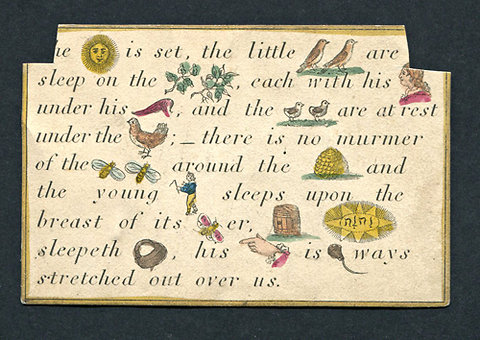
Image credit: James Phillips Williams, A hand-engraved and hand colored 19th century rebus card
part 9 of a series
Not by things
It is, of course, an indispensable part of a scrivener’s business to verify the accuracy of his copy, word by word. Where there are two or more scriveners in an office, they assist each other in this examination, one reading from the copy, the other holding the original. It is a very dull, wearisome, and lethargic affair. I can readily imagine that to some sanguine temperaments it would be altogether intolerable.
– Herman Melville, Bartleby the Scrivener
As it turns out, the German edition of the Dictionary of Important Words (Das Wörterbuch der wichtigen Wörter) was not the first. Soon after your sort, Homo nosce te ipsum, put pen to paper, they scribbled on and on about big, important concepts, transcendent ones even, a lot of them having to do with nice. Which means they were talking about them before they were able to write about them, which means you need a better origin story than the one Karl offered.
The Sumerians were the first to start using incised symbols to signify sounds rather than things. That clever maneuver is known among linguists as the “rebus principle,” from a Latin motto adopted by heraldic designers in Medieval times, non verbis sed rebus (“not by words but by things”). Which is an ass-end-up way to label a breakthrough running in the opposite direction. But that’s what 19th century linguists landed on, no doubt German ones, who, as has been learned, were not so good at naming. But that’s a story all of its own, the telling for another day.
Anyway, sometime in the late 4th millennium, maybe around 3200 BCE, pictograms were given double duty. So the picture of an arrow, ti in Sumerian, could also take on the meaning of “life,” til. In one of those ironic grace notes that makes the study of history so endlessly amusing, the city that first conveyed meaning in writing, Uruk, had a name without meaning, which was unusual. Nippur, another Sumerian city, meant “City of the Lord Enlil.” Not so Uruk, which anyway was originally called Unug by the Sumerians, until the Akkadians took to calling it uru-uk, neither version signifying anything, unless it did in some lost, pre-Sumerian language. That proved to be no embarrassment, as Uruk was associated with the great goddess Inanna (“the lady of Unug,” nin-UNUG), who herself experienced a name change, later coming to be known as Ishtar, later still assimilated with the Canaanite goddess Astarte, sometimes worshipped (along with Ba‘al) by pigheaded Israelites, earning them the LORD’s hot anger.
The Egyptians weren’t far behind. Sometime around 3100 BCE they pulled the rebus lever themselves. Now you could not only name and count the what, you could name the who. As in stringing together hieroglyphs to mean “fine wine from the estate of so-and-so”—a feat unachievable when only things and numbers of things could be catalogued in pictures. But such scribal dark arts seem to have sent a shiver down the spines of some Egyptian priests. After all, hieroglyphs were “sacred carvings,” best not defiled in profane use lest some LORD’s hot anger ensue. So, properly schooled, scribes developed a separate writing system, hieratic, for tedious administrative purposes.
Writing requires an origin story, as everything seems to demand an origin story for your sort. The Sumerian version was given in the legend Enmerkar and the Lord of Aratta, dating in written form to around 1800 BCE.
Enmerkar was the founding king of Unug (aka Uruk). He had quite the pedigree: his grandfather was the sun god Utu. He was a favorite of the goddess Inanna, chosen “in her holy heart from the bright mountain.” He reigned for 420 years, during which time he is credited for inventing agriculture and writing both. Pretty chesty. To the latter, he became embroiled in negotiations with the rival king of Aratta. Not very nice negotiations, as he was demanding submission and the payment of tribute. The back-and-forth went on and on. Somehow, good at so much else, Enmerkar managed to appoint a messenger incapable of remembering all the jawing the negotiations entailed, requiring a work-around:
Because the messenger’s mouth was heavy and he could not repeat the message,
the lord of Kulaba [Enmerkar]
patted some clay
and put words on it, like a tablet.
Until then, there had been no putting words on clay.
But now, for the first time, he put words on clay.
He inscribed the message as if it were on a tablet.
He gave it to the messenger.
The messenger set off on the road to Aratta.
He carried the tablet of the lord of Kulaba.
Or so goes one story. As you might expect, the Egyptians had their own version.
The Egyptian god Thoth was ancient of days—except the Egyptians didn’t call him Thoth. The Greeks did (Θώθ), borrowing from the Coptic Ⲑⲱⲟⲩⲧ Thōout. Maybe Ra knows where that came from…. To the Egyptians he was ḏḥwtj “[he] is like the ibis”. Which makes sense of why he is often pictured with the head of an ibis, but no sense of why just as often he was pictured with the head of a baboon. Whatever, Thoth was a god of many things: the moon, wisdom, knowledge, writing, hieroglyphs, science, magic, art and judgment. Importantly, his wife was Maʽat (on whom more to follow). And when you have a god in play, you really don’t need much of a story. Gods just do stuff. So it was with the invention of writing, as you’re told in a coffin text from around 2000 BCE:
It is Thoth who gives writing,
who teaches the scroll to mankind,
who makes the gods strong through his words.
There you go.
By the middle of the 3rd millennium BCE, writing—that breakthrough only a scrivener could love—was pressed into higher service. Immanent pictograms, reborn as phonemes, were strung on a charm bracelet to express transcendent concepts—many of the moral variety, as the worlds those doing the writing were moral ones. That was the only sort on offer.
Thus you have the Sumerian king Urukagina in 2400 BCE announcing ama-gi₄ in various decrees. Translated literally it means “return to mother,” where debts were forgiven or persons restored to liberty—a kind of moral/equitable reset of society and the first known word in writing for the concept of freedom. Or a bit later, maybe 2100 BCE, king Ur-Namma of Ur establishing “justice/equity/fairness” (níĝ-si-sa₂) and “truth” (níĝ-gi-na,) in the land.
And they had the most Important Word of all, me, meaning “divine ordinances,” ethical laws decreed by the gods establishing the fundamental norms of civilization.
Thus words with moral valence appear in Egyptian Pyramid Texts of Unas (5th Dynasty, c. 2350 BCE). These are funerary texts containing spells and incantations. They speak of the king being “justified” (mꜣꜥ-ḫrw, lit. “true of voice”) among the gods. They recognize the moral force of speech: the true sort that creates order (hu) contrasted with the false sort that suggests moral corruption (grg).
But what carried the most moral water in Egypt was a single, pregnant rebus. Let the hieroglyph for owl (𓅓) signify the phonetic value m. Pair that with the hieroglyphs for vulture (𓄿) and a bread loaf (𓏏), signifying a glottal stop and t, respectively, and you get Maʽat.
The shorthand translation is “truth, justice, cosmic order,” which would seem quite enough, but Maʽat did a lot more work than that. Maʽat had 42 “Ideals” representing balance and order of every sort. Everything had its place in the world, including people, society, the seasons, the gods. Maʽat kept the stars in motion, the seasons changing and maintained the proper arrangement of things both in and between Heaven and Earth. Egyptologists, struggling to distill all that Ma’at contained, came up with seven principles describing her essence (or its, as Maʽat could be an abstract principle as well as a goddess): Truth, Justice, Order, Balance, Harmony, Compassion, Reciprocity.
In contrast to Maʽat, the Sumerian me was never personified. It required no rebus, as it could be represented by a single phoneme, 𒈨. In fact, it wasn’t an it: there were dozens of me’s, perhaps hundreds. They were ordinances originally collected by the high god Enlil (the Lord of Nippur), and then entrusted to the guardianship of Enki. Which is weird, because Enki was a trickster god. But maybe that makes sense, because whereas Maʽat was always about nice (truth, justice, etc.), me’s were both nice and not-nice (justice and falsehood, wisdom and strife). And unlike Ma’at, me’s didn’t intersect with personal morality; they were all about political order—gods, kings, cities, that sort of thing. To keep the plebs in order, Sumerians relied on legal codes, contracts, temple rituals and social pressure.
So, as it happened, the first edition of the Dictionary of Important Words was written by the Sumerians in the mid 3rd millennium BCE. This is the first moral vocabulary in recorded human history. It was revised shortly thereafter, as the Egyptians had Important Words to add about a hundred years later.
The second edition was some time in coming, published in the 2nd millennium with contributions from India (in Vedic Sanskrit). China made contributions in the mid 1st millennium, leading to the fourth edition. Other editions were to follow (see Handy Table 1). It bears noting that the rebus lever was first pulled for practical purposes—counting, accounting, recording, things of that sort. It took a bit of time to realize the transcendent potential in that bureaucratic trick. Sometimes more than a bit.
And if you were a serious dictionary browser (unlikely as that may be), you might notice that the first revised edition is both One and Not-the-Same. That is, the moral universes the Important Words describe for Sumer and Egypt are similar in a structural way, but dissimilar in their particulars. And it’s in the particulars where your sort, Homo nocse te ipsum, lives and dies.
On the One side, both cultures, already in the 3rd millennium BCE, identify truth, justice, order, fairness, and compassion as the backbone of morality. In both traditions, kingship is legitimated by protecting the vulnerable. Pretty nice. And, in real kingdoms! Not the sort later promised by Someone(s?) who, two (six?)-fingers-behind-the-back(s?), is (are?) said to have had his (their?) own definition of a word otherwise clear in meaning.
And if you’re so inclined, you might just crank the telescope knob to look further back in time, long before the 3rd millennium BCE. All the way to six or seven million years ago, well before there was pen to put to paper, when the ancestor that can only be imagined is said to have existed, endowing Pans and Homo nosce te ipsum alike with a common set of behavioral propensities, often referred to as moral foundations (a recent addition to the Dictionary of Important Words). What your squinting eye will see is that the moral vocabularies of both Sumer and Egypt map very neatly onto biologically rooted moral foundations (see Handy Table 2).
Their Oneness was come by naturally: a family resemblance.
On the Not-the-Same side of the ledger, to the particulars. Sumerian Important Words concerned civic justice and social equity in this world; morality was pragmatic, plural (lots of me’s), centered on law codes, social reform and earthly justice. You might call them proto-Woke, the original social-justice warriors.
The Egyptian Important Words, on the other hand, were cosmic, singular (one Ma‘at), eternal, centered on Pharaoh and the afterlife. Morality was about living in harmony with Ma‘at and being judged by it eternally. You might call them proto-MAGA, as they tended to look on foreigners (Nubians, Asiatics, Libyans and other riffraff) as impure, malign bearers of disorder and chaos (isfet).
As to the most important particular of all, the afterlife, the perspectives of the two cultures could hardly be more Not-the-Same. Egyptians who lived in accordance with Maʽat’s 42 ideals (see Handy Table 3) were admitted to the Field of Reeds, a blessed afterlife. Those who failed were thrown to Ammit, the “Devourer” (a hybrid monster with crocodile, lion, and hippopotamus parts) to experience a second death and annihilation. For Egyptians, the ultimate fear was not eternal torment, but oblivion.
The Sumerians had no hope of a blissful afterlife; no moral sorting was done, no behavior-changing threat on offer. All Sumerians—however righteous or wicked, whether a king or a commoner—ended up as ghosts (gidim) in the “land of no return,” (kur-nu-gi₄-a), a gloomy place where the only meal on offer was clay and muddy water. Imagine that, a civilization lasting thousands of years with no eternal gun to the head, no word describing a place of perpetual torment.
“Hell” wasn’t added to the Dictionary of Important Words until the Church Fathers got the concept properly nailed down in the 4th century CE, thanks in large part to one Aurelius Augustinus Hipponensis, who, though sainted, would have had no chance of finding himself in the Field of Reeds.
Here’s a metaphor. Which, thinking of it, how weird are metaphors? You go from a picture of a thing to a picture meaning a sound to a cluster of pictures meaning a word that actually names something, to a word that pretends to name something by naming something else entirely. Honestly, who would ever do that? It’s surprising that such an adulteration wouldn’t incur the LORDS’s hot anger, as that’s not at all what naming was supposed to be about. Oh wait, it has. The history of your sort, Homo nosce te ipsum, is filled with some LORD’s hot anger. So it’s your fault.
Trouble is, metaphors can be handy, especially when explaining complex notions to the dim witted, which is a fair characterization of your sort, generally speaking. Parables are maintained by some to perform the same service, which is generally untrue. They’re more for making a mess of things, like calling a kingdom a mustard seed, which, if you’re at all honest, you have to admit makes no sense.
The Sumerian and Egyptian One can be pictured as a typewriter, the keys being the moral foundations both civilizations inherited from the common ancestor that can only be imagined, itself metaphorically: a mosaic. The manufacturer of the typewriter is evolutionary biology.
But a typewriter can be made to tell many stories—and no, it’s not monkeys stomping across the keys to produce Shakespeare. That’s a metaphor so lame as to deserve heaps of hot anger. The author, metaphorically speaking, banging the keys, is the environment. Except that there’s more than one environment, so more than one author, leading to a cacophony of stories and even genres.
Thus, if your particular sort (tribe) found itself in a forest—with dense vegetation, limited visibility, strange sounds echoing around, lots of critters, some nice (to eat) and some not-so-nice (likely to eat you)—your world will be animated by spirits. Every tree, rock and river enchanted, divine beings within rather than above the world. A dangerous place, requiring shamans to help you have any chance at all. That is a genre someone named animistic.
If, on the other hand, your particular sort found itself in the desert, you’ll have a taste for a singular god, bellowing out orders (laws) and running the show, above the world rather than within it. Why? Because deserts are miserable landscapes that stretch as far as the eye can see, largely bereft of life and dry as a bone. Your survival depends on a single source, maybe an oasis, maybe the rare rainfall, your thirsty herds. In an environment with little margin for error, divine law becomes absolute, nice and not-nice envisioned in a duality as brutal in its simplicity as the environment itself: light/dark, good/evil. That is a genre named monotheism or (more technically) moral monism.
But that’s just the beginning of the story, as everything having to do with nice for your sort seems to go from weird to weirder still. For example, you might find yourself in a tropical rainforest with a long history of enacting the story your environment wrote, animism, but now playing your part in an entirely different story written in an entirely different genre, monotheism, worshipping the most recent iteration of an ancient desert god. So Indonesia finds itself the most populous Islamic nation, a curious switch attributable a bit to trade, a bit to missionary work (dawah) and a whole lot to the LORD’s hot anger in the form of conquest.
Curiously, Sumer and Egypt belong to the same genre, as they were both civilizations that found themselves in river valleys. That’s gotta be one author, right? Wrong.
Sumer found itself in the valleys of the Tigris and Euphrates rivers, which flooded irregularly and often catastrophically. Irrigation systems were needed to tame them, demanding constant repair. Salinization eroded farmland, which was not great for those addicted to Enmerkar’s invention, agriculture. Worse still, the wide alluvial plain was an open invitation to Gutians, Amorites, Elamites and the like to meet out the same treatment Joshua gave to Jericho. In short, that world was fragile, contested, unstable, requiring continuous human effort to prevent chaos. Order could not be assumed but had to be established, only to need reestablishing when something went wrong, as somethings are wont to do. A chore left to mortal kings, issuing from their high castles new justice decrees, writing new law codes, cancelling old debts (ama-gi₄) for urban populations seemingly prone to making dodgy investments. All to keep the metaphorical train on the track.
And so Sumer found itself with a version of nice, a moral vocabulary, of a plural sort, lots of me’s needed to establish truth, fairness, freedom, justice. Over time and over and over again.
Egypt, in contrast, found itself along another river, the Nile, which flooded annually on a regular cycle, like breathing in and out. Predictable harvests allowed central granaries to be built, managed by semi-divine Pharaohs ruling in dynastic succession, not challenged by malign foreigners all that often. Famines could be mitigated, large monuments could be built. It was a relatively stable environment situated in an ordered and harmonious cosmos. Disorder (isfet) was an exception proving the rule.
And so Egypt found itself with a different version of nice, an eternal truth, with Pharaoh as guarantor of the singular Ma‘at.
And there you have it: different environments using the same contraption to bang out different stories in various genres—even different stories within the same genre. This in a process known as cultural evolution which, with its biological sibling, explains nearly all of One and Not-the-Same when it comes to nice. Or, in a more poetic metaphor, Not-the-Same defeated father One just as Zeus defeated father Cronos, ending a Golden Age of nice.
Of the something like nine billion of your sorts infesting the planet, fair guess that maybe 8.998 billion believe in some sort of divine whatever. Overseeing the world as it’s come to be, maybe intervening in it from time to time, maybe battling the dark principalities and powers arrayed against your particular sort, who of course have the obviously right version of nice, victory in the end assured. In any case, something greater somehow cranking the meat grinder that is la condition humaine, as Malreux had it.
And even if you accept the explanation of One (evolutionary biology) and Not-the-Same (cultural evolution)—which you’re not likely to. Not really. You may give it lip service so you don’t appear entirely Neanderthal in educated company. And you know? That’s how the Union’s founders wanted it, knowing that pretty much everyone was likely to be a religious Neanderthal and hoping to exorcise that from political discourse, as it led to all manner of wars and bloodletting.
Not to be mean, but that sorta makes them dopes.
But more likely than not, statistically at least, you have your own version of divine Ma‘at, your own set of divine me’s, the source of your version of nice, which you find transcendently compelling. Why? Because nice demands a better story than monkeys and time, which is not a good story at all. Nor is stuff bumping into stuff, which, besides being a bad story, tends to reduce cherished Ideals and the divine whatever that surely authored them to stubbed toes. That will not do, not for Homo nosce te ipsum, the nosce part demanding a better tale, one told by words, not by things.
Which you know?, fine.
Handy table 1
Comparative Table of Early Equivalents to “Moral/Morality”
| Culture / Language | Term(s) | Literal Meaning | Earliest Attestation | Notes on Moral Use |
|---|---|---|---|---|
| Sumerian | ama-gi₄ (𒂼𒄄) | “Return to mother” → freedom, release | Reforms of Urukagina, Lagash (c. 24th c. BCE) | First known “liberty” proclamation; release from debts/bondage. |
| níĝ-si-sa₂ (𒉆𒋛𒊬) | “The straight/equal matter” → justice, fairness | Ur-Namma Law Code (c. 2100 BCE) | Standard for fair judgment in law and royal prologues. | |
| níĝ-gi-na (𒉆𒄀𒈾) | “The true thing” → truth | Ur-Namma (c. 2100 BCE) | “To establish truth in the land”; linked to justice. | |
| me (𒈨) | Divine ordinances, cosmic norms | Proto-cuneiform (c. 3100 BCE) | Cosmic principles incl. justice, truth, wisdom, kingship. | |
| Egyptian | Ma’at (mꜣꜥt) | Truth, justice, order | Pyramid Texts of Unas (c. 2350 BCE) | Central principle; “Unas lives on Ma’at.” |
| mꜣꜥ-ḫrw | “True of voice / justified” | Pyramid Texts of Unas (c. 2350 BCE) | Epithet of vindication; deceased morally justified before gods. | |
| ḥw (Hu) | Authoritative, truthful speech | Pyramid Texts, Coffin Texts | Truthful speech enacts order; linked with Ma’at. | |
| iri ib nfr | “Act with a good heart” | Instruction texts (Middle Kingdom) | Ethical exhortation: benevolence, good intention. | |
| wdj (wḏꜣ) | To prosper, be intact, whole | Wisdom texts | Moral wholeness, reward of living in accordance with Ma’at. | |
| Akkadian (Mesopotamia) | kittum, mīšarum | Truth, justice, equity | Old Babylonian (c. 1900 BCE) | Found in Hammurabi’s prologue: “to establish kittum and mīšarum in the land.” |
| India (Vedic Sanskrit) | Dharma (धर्म) | Law, duty, righteousness | Ṛgveda (c. 1500–1000 BCE) | Cosmic and social order; later expanded philosophically. |
| Śīla (शील) | Conduct, moral discipline | Pāli Canon (c. 3rd–1st c. BCE oral) | Buddhist ethical precepts. | |
| China (Classical Chinese) | 德 (dé) | Virtue, moral power | Shujing (1st millennium BCE) | Central to Confucian/Daoist thought. |
| 礼 (lǐ) | Ritual propriety, norms | Classic of Rites (c. 3rd–2nd c. BCE) | External enactment of moral order. | |
| Hebrew Bible | צֶדֶק / צְדָקָה (ṣedeq / ṣĕdāqāh) | Justice, righteousness | Prophets (8th–6th c. BCE) | Core covenantal virtue. |
| מִצְוָה (mitzvah) | Commandment | Torah (c. 10th–5th c. BCE) | 613 mitzvot = moral + ritual law. | |
| Greek | ἦθος, ἠθικά | Custom, character → ethics | Homer (8th c. BCE); Aristotle (4th c. BCE) | Basis of Western ethical philosophy. |
| Latin | moralis, moralitas | Pertaining to mores → morality | Cicero (1st c. BCE); Augustine (4th–5th c. CE) | Translations of Greek ethical terminology. |
| Arabic / Islamic | ʿAdl (عدل) | Justice, fairness | Qurʾān (7th c. CE) | Central divine attribute and human duty. |
| Akhlaq (أخلاق) | Character, ethics | 10th–11th c. CE (Miskawayh, al-Ghazali) | Classical Islamic moral philosophy. |
handy table 2:
biological foundations of morality in egypt and sumer
| Moral Foundation | Egyptian Vocabulary | Sumerian Vocabulary |
|---|---|---|
| Empathy & Consolation | Compassion in Ptahhotep (“Do not ill-treat the weak”), Merikare (“Calm the weeper, nourish people”). Negative Confessions: “I have not caused weeping.” | ama-gi₄ (“return to mother”) → release from debt/bondage = recognition of suffering. Royal decrees framing reforms as protecting widows, orphans, the poor. |
| Reconciliation & Conflict Management | Ma’at as harmony: “Do not stir up strife” (Book of the Dead 125). Role of judges: “Do not favor the strong over the weak.” | níĝ-si-sa₂ (justice, fairness) and law codes that regulate disputes. Ur-Namma prologue: kings “established equity and banished violence.” |
| Long-Term Social Memory | Ma’at as “undisturbed since the day of its creator” (Ptahhotep) = morality rooted in cosmic permanence. Scribal instructions preserving wisdom across generations. | me = divine ordinances, eternal cultural norms. Law codes carved in stone for posterity (Ur-Namma, Hammurabi). |
| Reciprocity | Ptahhotep: “Do to the doer to cause that he do” (early reciprocity maxim). Confessions: “I have not cheated in the balance.” | Law prologues: “so the strong may not oppress the weak” → reciprocal protection. Weights/measures regulated under níĝ-si-sa₂ (justice, fairness). |
| Group Identity & Parochialism | Pharaoh as guarantor of Ma’at for Egypt; foreigners often linked with isfet (chaos). Rituals reinforce Egyptian identity as “people of Ma’at.” | Kings invoke justice for their umma (community). Cities defined moral space—Urukagina boasts of reforms for Lagash, not all Mesopotamia. |
| Norm/Convention Learning | Ma’at embedded in etiquette: speech (Hu), listening (Sedjem). Wisdom literature as moral instruction for scribes and officials. | Scribal schools used proverbs and model contracts to teach fairness. me = cultural packages of norms, transmitted socially. |
| Inequity Sensitivity | Amenemope: “Do not tilt the scales or falsify weights.” Ma’at as balance, depicted in judgment scene. | níĝ-si-sa₂ literally means “the straight/equal thing.” Debt cancellations (ama-gi₄) as correction of inequities. |
| Emotion Regulation & Social Tolerance | Ptahhotep: “Do not be arrogant, hot-tempered, or proud.” Confessions: “I have not been angry without cause.” | Wisdom proverbs (e.g., “Do not speak arrogantly; do not be boastful”). me included proper conduct, restraint. |
| Reputation Awareness | Tomb inscriptions stress being remembered as “justified” (mꜣꜥ-ḫrw, true of voice). Instruction texts emphasize a “good name” that outlives the body. | Kings boast in prologues of being “protectors of justice.” Individual reputation tied to oath-keeping; níĝ-gi-na = truth as social reliability. |
| Sanctity/Purity-Like Rule Following | Purity rituals linked with Ma’at: “I have not polluted the water” (Confession 42). Moral order tied to cosmic/ritual purity. | Taboos and ritual laws embedded in temple regulations. Purity concepts not as explicit as Egypt, but me included cultic norms and ritual propriety. |
handy table 3:
the ideals of ma’at
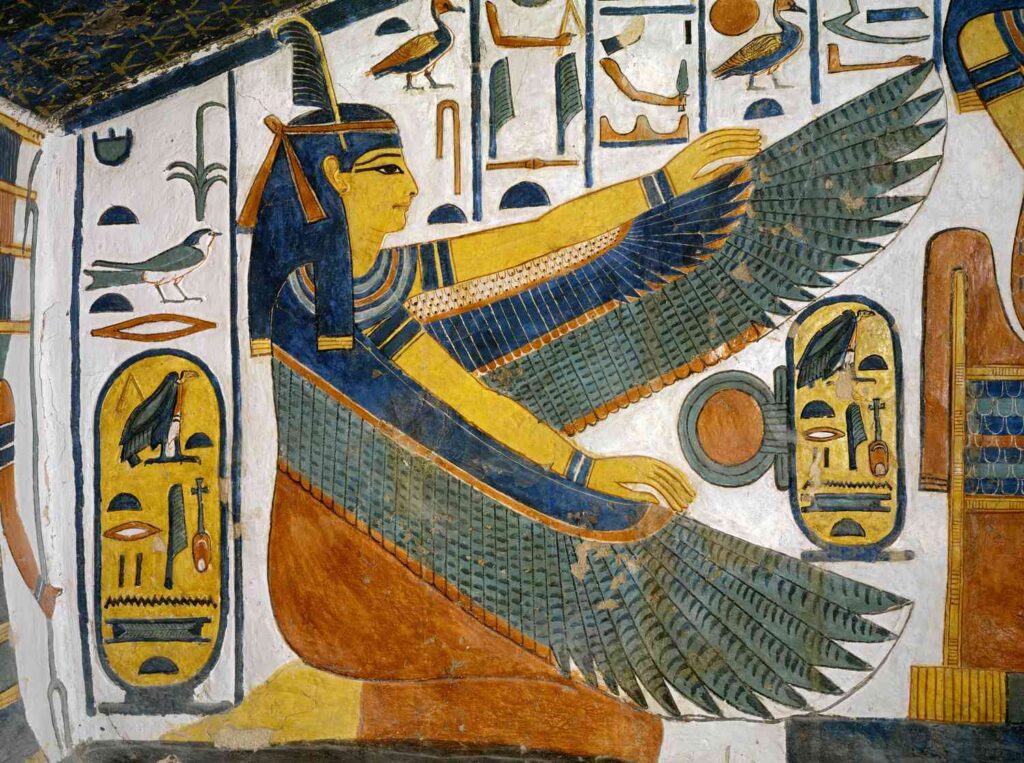
Ma‘at personified as a goddess
The Papyrus of Ani is one of the most complete examples of the funerary texts collectively. It was prepared for prepared for the priest Ani of Thebes (c. 1250 BCE). Known in English as the “Book of the Dead,” its literal translation is the “Book of Coming Forth by Day.” The papyrus manuscript contains the 42 Ideas of Ma‘at, comprising both negative confessions and positive affirmations that represent the deceased’s claim to having lived according to Ma‘at—the ancient Egyptian concept of truth, justice, cosmic order, and balance.
Presented before the 42 divine judges in the Hall of Two Truths, these declarations include both denials of wrongdoing and affirmations of righteous deeds, creating a comprehensive moral framework that demands not merely the absence of evil but the active practice of virtue.
The significance of the number 42 is deeply rooted in Egyptian cosmology and geography, corresponding to the 42 nomes (administrative districts) of Upper and Lower Egypt, with each judge representing one nome and ensuring that the deceased had lived righteously throughout the entire land. These declarations, found not in a single standardized “book” but rather in various funerary papyri customized for individual deceased persons, served as both a legal defense and a spiritual passport, with the heart of the deceased weighed against the feather of Ma‘at to determine worthiness for the afterlife—a judgment that required demonstrating both purity from transgression and commitment to compassionate action.
| Declarations of Innocence | Positive Affirmations |
|---|---|
| 1. I have not committed sin | 1. I honor virtue |
| 2. I have not committed robbery with violence | 2. I benefit with gratitude |
| 3. I have not stolen | 3. I am peaceful |
| 4. I have not slain men and women | 4. I respect the property of others |
| 5. I have not stolen food | 5. I affirm that all life is sacred |
| 6. I have not swindled offerings | 6. I give offerings that are genuine |
| 7. I have not stolen from God | 7. I live in truth |
| 8. I have not told lies | 8. I regard all altars with respect |
| 9. I have not carried away food | 9. I speak with sincerity |
| 10. I have not cursed | 10. I consume only my fair share |
| 11. I have not closed my ears to truth | 11. I offer words of good intent |
| 12. I have not committed adultery | 12. I relate in peace |
| 13. I have not made anyone cry | 13. I honor animals with reverence |
| 14. I have not felt sorrow without reason | 14. I can be trusted |
| 15. I have not assaulted anyone | 15. I care for the earth |
| 16. I am not deceitful | 16. I keep my own council |
| 17. I have not stolen anyone’s land | 17. I speak positively of others |
| 18. I have not been an eavesdropper | 18. I remain in balance with my emotions |
| 19.I have not falsely accused anyone | 19. I am trustful in my relationships |
| 20. I have not been angry without reason | 20. I hold purity in high esteem |
| 21. I have not seduced anyone’s wife | 21. I spread joy |
| 22. I have not polluted myself | 22. I do the best I can |
| 23. I have not terrorized anyone | 23. I communicate with compassion |
| 24. I have not disobeyed the law | 24. I listen to opposing opinions |
| 25. I have not been excessively angry | 25. I create harmony |
| 26. I have not cursed God | 26. I invoke laughter |
| 27. I have not behaved with violence | 27. I am open to love in various forms |
| 28. I have not caused disruption of peace | 28. I am forgiving |
| 29. I have not acted hastily or without thought | 29. I am kind |
| 30. I have not overstepped my boundaries of concern | 30. I act respectfully of others |
| 31. I have not exaggerated my words when speaking | 31. I am accepting |
| 32. I have not worked evil | 32. I follow my inner guidance |
| 33. I have not used evil thoughts, words or deeds | 33. I converse with awareness |
| 34. I have not polluted the water | 34. I do good |
| 35. I have not spoken angrily or arrogantly | 35. I give blessings |
| 36. I have not cursed anyone in thought, word or deed | 36. I keep the waters pure |
| 37. I have not placed myself on a pedestal | 37. I speak with good intent |
| 38. I have not stolen that which belongs to God | 38. I praise the Goddess and the God |
| 39. I have not stolen from or disrespected the deceased | 39. I am humble |
| 40. I have not taken food from a child | 40. I achieve with integrity |
| 41. I have not acted with insolence | 41. I advance through my own abilities |
| 42. I have not destroyed property belonging to God | 42. I embrace the All |