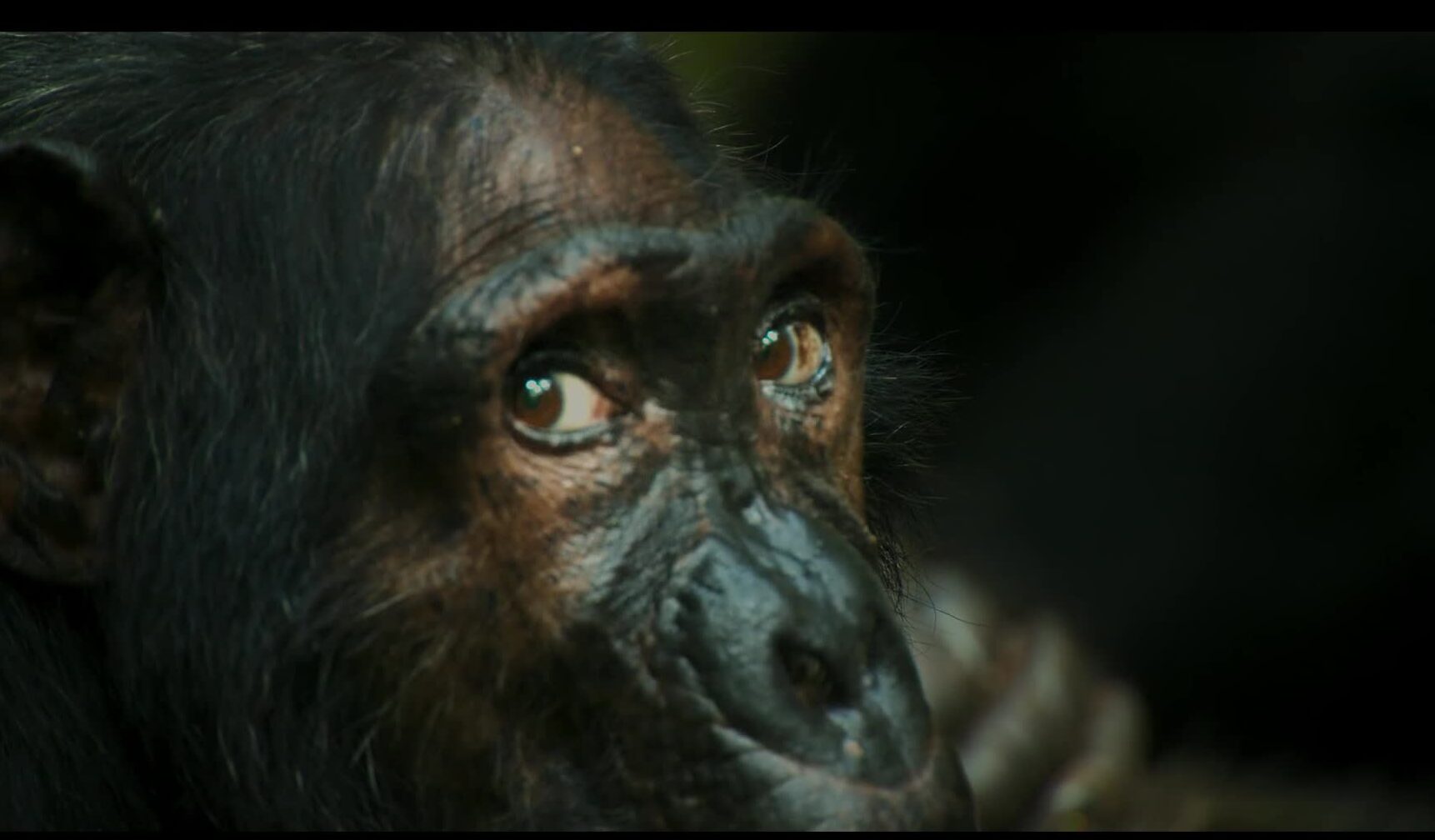
Image credit: Pincer, The Ngogo Chimpanzee Project
part 6 of a series
But thinking makes it so
“You know what I say to people when I hear they’re writing anti-war books?”
“No. What do you say, Harrison Starr?”
“I say, ‘Why don’t you write an anti-glacier book instead?’”
–Kurt Vonnegut, Slaughterhouse Five
If there can be seen any glimmer of hope for your sort, Homo nosce te ipsum, it would be an example of a feral pack of ideologues succumbing to actual facts learned and changing their minds, however painfully, grudgingly and incompletely. Orthodox religious types? No, they’re hopeless. Anthropologists. Their central dogma maintained that human culture was free of causation from lower sources, in particular biological sources. Culture had nothing to do with nature, the former being learned, the latter instinctive—what was human was cultural, what was not was merely animal (merely doing the ontological work there). Any suggestion to the contrary raised a chorus of prophetic excoriations so morally devastating as to be fatal: “Reductionism!” “Genetic determinism!” “Eugenics!” and the coup de grâs, “Racist!!”
If you think said accusations couldn’t really have been hurled—and at volume—because scholars are serene in their detached rationality and empirical rigor, ever committed to the search for truth, thus dispositionally above condemnation of the biblical variety (said variety having concerns other than truth), you would be sorely mistaken.
So when Victor Turner, a luminary in the self-declared field of nosce te ipsum (anthropology), considered evidence that ritual, a favorite topic of the feral pack, could have a neurological basis, he found the process as painful as a Christian might in reconciling the modern abhorrence of genocide with the divine taste for it. In his 1983 paper, “Body, Brain and Culture,” Turner wrote:
The present essay is for me one of the most difficult I have ever attempted. This is because I am having to submit to question some of the axioms anthropologists of my generation—and several subsequent generations—were taught to hallow. These axioms express the belief that all human behavior is the result of social conditioning. Clearly a very great deal of it is, but gradually it has been borne home to me that there are inherent resistances to conditioning.
It only took a century for them to come around. And not all have. Anthropologists still under the spell of postmodernism and critical theory of whatever sort want nothing of biological explanations—especially of behavior. For them, it seems to be fine to be a cis-gendered white male, so long as you’re French and write in prose so purposely opaque that it must be profound, providing fodder for endless dissertations never to be read. Not unlike the American heartland, where everyone is nice, so long as you’re white, straight and love Jesus. Otherwise not so much. The difference being a lack of dissertations. Which, you know?, something to be said for that.
So tight the grip of hallowed axioms.
However much an insult it might be to your sense of self or your hallowed axioms, you didn’t have all that much to do with what finally became yourself. Setting aside your physical self, you didn’t even have much to do with the other bits: your proclivities, tastes, habits. The way you cross your arms. Even your deepest moral intuitions—which, in your case, might be a relief. Some other to blame.
So what might have?
If you have an answer in the form of a who rather than a what, well, you’re in the majority. So there’s that. Go forth and conquer.
But on the off chance that you have more of an interest in learning than asserting, you’re left with the what. Still, wouldn’t it be nice if there were a simple answer, a neat what? Luckily for you, given your aversion to ambiguity, there is: evolution. Solves pretty much everything (except for anthropologists). And thinking about it, that simple what can be paired with a who, in which case you end up with theistic evolution. Like Francis Collins, the guy who cracked both the genome and, with the aid of C. S. Lewis and a frozen waterfall in the Cascade Mountains, the deepest truth of all! What could be a more felicitous reconciliation of old foes? Like wolves living with goats, calves with lions, which you probably think is going to happen one day. No doubt Francis does.
In advance of that happy eschaton (or being unpersuaded by apologists and frozen waterfalls), you are left to do your best on Planet Maturia, where little learning comes unencumbered by ambiguity. As an example: it would be a fair assumption that, as Homo nosce te ipsum and the Pans share nearly 99% of their DNA, whatever behaviors are common can be reasonably inferred to have existed in the last common ancestor (LCA), which would indicate a deep genetic inheritance for the behavioral proclivities of your sort. Not in the straw man deterministic sense (the beloved punching bag of anthropologists and apologists alike), but as strong propensities. The you you had little to do with.
Which led, among the what-oriented types, to endless discussion of which of the Pans (your sort being such an outlier) might serve as a relatively good template for imagining the thing that there is no evidence of, the LCA. Bonobos are just weird, in every sort of way. Their dominance hierarchy is female, for heaven’s sake! And they’re constantly having sex to solve spats! They will welcome strangers as often as fight them! In short, they’re just too nice to be taken seriously. (Though, as more has been learned, less nice than initially thought, but still). There also aren’t all that many of them. So some, but not many, proposed that tribe as the LCA template.
Chimps seemed to be a better bet. After all, setting aside hippies—who just want to get stoned, have free sex, put daisies in the barrels of assault rifles and live off their much-hated parents income—they seem to map better to your sort. Some have gone so far as to argue that chimps stopped evolving altogether, having hit the environmental jackpot (stable environment in the tropical forests of Central and West Africa, plenty of food, plenty of room, that sort of thing), which pretty much eliminated selective pressure. Not unlike being born in America.
But what about evolution by random mutation? you might ask, if you had been paying attention in your high school biology class, assuming that class was not held in your home and taught by your evangelical mother, or in a public high school in Oklahoma.
Good question. The argument was that most mutations are either neutral or deleterious, which does sorta seem to dent Darwin’s central thesis…. But whatever. The stake in the heart of the “stasis via stable niche” claim was additional information. Imagine that! Learning more as you go along. There’s a nickel, buy a clue.
As more chimp groups were observed across Africa, it turned out that they show a good bit of behavioral variation (technically termed “ecological/behavioral plasticity”). Chimpanzee communities vary dramatically—in diet (hunting frequency, nut-cracking, termite-fishing), tool repertoires, social aggression, even grooming conventions. Some populations innovate or retain cultural traditions others have no holy idea of. So if things were so stable, why the differences in behavior? Looks like chimps were evolved for flexibility, not stasis.
And it’s even worse than that, if you’re allergic to complexity, which you likely are, as are almost all of your sort. Not to beat a dead LCA, but things can get weird. For example, a similar trait can appear in different lineages because they were subject to similar selective pressures. This is known as homoplasy, and an example is cooperative hunting. Your sort and one of the Pans (chimps) both do it, but that doesn’t necessarily imply an ancestral trait. And then there’s the mouthful, reticulate evolution, which is a fancy way of saying the break between lineages isn’t always neat and clean. Genomic studies point to “incomplete lineage sorting,” possibly because early versions of your sort and the Pans were having biblical relations. Thus, shared traits might not point to an ancestral trait but rather a product of that most powerful needs must.
Tired of all of this and somewhat worldly wise (if in no other way), you mutter, Here it comes. “All that being said….”
Followed by the correction, It’s “all that having been said,” you illiterate dope.
At which point the third you gives up.
All that having been said, a general if provisional consensus has emerged of the LCA, the ancestor that doesn’t exist but is believed to have once, some 6–7 million years past. It was not a bonobo. It was not a chimp. It certainly wasn’t a Homo nosce te ipsum. In an apparent attempt at poetic expression, scientists call it a “mosaic.” Not in the sense that it was a collage of Pan and Homo traits, but rather a patchwork of inherited and derived traits.
But, you protest, that’s entirely unhelpful, as that describes every organism!
Right. Maybe leave poetic expression to poets?
Anyway, the thing that can only be imagined to have existed probably had a flexible approach to group formation, formally known as “fission-fusion”, with size and composition changing frequently within the lifetime of members as groups split (fission) or merged (fusion) depending on environmental conditions or individual requirements. Probably some powerful individual’s requirements…. Group politics were likely managed through coalitions, which, besides structuring the group, were useful when aggression toward rival groups seemed the better play. Communication was almost certainly gestural, with a repertoire as rich as modern Italians. Social memories were likely long (friends and foes recognized for decades), and juveniles were dependent for a near eternity, which is how long it took for the tykes to pick up social learning–based norms and traditions. (See Handy Table 1.)
Sound familiar? Add language to that mix, and you have a pretty good description of Homo nosce te ipsum. Human history is a long tale of fission-fusion, with political groupings aggregating only to disaggregate: empires (e.g., Rome), nation-states (e.g., Yugoslavia), political ideologies (e.g., your beloved liberalism). Coalitions are ubiquitous and ever shifting, intergroup aggression (aka, war) the norm. Bulgarians still remember in song the insults suffered centuries ago (long social memory); the Dutch national anthem, the Wilhelmus, celebrates the nation’s hard won independence from the Spanish Empire (fission); the Union’s Great Seal carries the motto, e pluribus unum (fusion) on the obverse, the reverse adding Annuit cœptis (“He approves the undertaking”) and Novus ordo seclorum (“New order of the ages”). Pretty chesty.
Your neocortex—the only you you are aware of, that endlessly chattering cage of monkeys—took 25 years to construct, putting enormous strain on your parents and society both. Why? You might guess that its cells are particularly complex, or maybe the wiring. In which case you would be entirely incorrect. It’s because that’s how long it takes for you to learn and internalize the norms of the society you landed in, mores built on the scaffolding you inherited from the thing that can only be imagined.
What, you might well be wondering, does any of this have to do with “nice”?
Which confirms it: you are a dope. What you call “nice” or “altruism” or whatever is what what types (scientists) as opposed to who types (theologians, apologists) call inherited behavioral propensities. The you you had little to do with. Far from your hallowed axiom that morality most distinguishes your sort from lesser sorts (known and imagined), you were born in a species related to other species, all of you sharing an ancestor and receiving as compensation for existing a toolkit hard won through the meat grinder that is natural selection. Including tools you think of as so uncharacteristically nice that they must have come from some other source. God or whoever. Which, maybe so. But if so, he forged the grinder and cranked its handle for a long, long time.
Out of the box you get a whole bunch of things you had nothing to do with and couldn’t get rid of even if you desperately tried. You are primed to show empathy, at least to group members. You’ll console a friend, even an unrelated one. You will feel loyalty to your group, internalize its norms, employ (unaware) confirmation bias to defend it (the group) and them (the norms). You will feel great pleasure at punishing violators (stoning disobedient children, performing honor killings) and exterminating the non-chosen (Canaanites, Talibani, Gazans). On and on (see Handy Table 2). None of those things, none of the things that are part of your hallowed moral horizon, did you have anything to do with.
Could you still cheat? Sure, but there will be a cost. Nature, or at least the nature on this planet, operates as a drug dealer. You’re the junkie. It has a whole cabinet of neurochemicals designed to keep you in line, your neocortex being insufficient by itself. Drugs to reward you when you tow the line and punish you when you stray. (See Handy Table 3). And the dealer has been in business for a very long time. Early vertebrates (≥500 mya) already had dopamine, serotonin, stress hormones, and amygdala-like structures for reward, mood, and fear regulation. All that for fish, amphibians, and reptiles.
The dealer cooked up additional chemicals for early mammals (≥90 mya), adding oxytocin/vasopressin for bonding, endorphins for social stress relief, and more complex limbic circuits (ACC–amygdala), the resulting high enabling stronger parental care and social bonds.
That most hallowed set of axioms, the Sermon on the Mount, blessings and woes both, is just a way of telling that story, one having a deep evolutionary history. The person alleged to have preached it had the same. It was all writ long before there existed any creature capable of imagining the god you likely believe in, or wish you could.
You once heard someone say that, without their god (the one who preached the Sermon) looking down on them, they would be the worst sort of person they can imagine. Cheating, lying, taking advantage, defecting at every chance. And yeah, maybe. That person would be known as a sociopath. It happens. But they wouldn’t be a normal Homo nosce te ipsum. That person would be a freak. Of nature.
Or, maybe there is a Crank who’s been cranking the grinder for so very long.
को अद्धा वेद. Who in truth knows?
Here’s the thing about nice: it’s all well and good for your tribe, but not so much for others. In fact, you tend to hate others. Doesn’t take much; maybe their tribe doesn’t part their hair the way yours does. Maybe they eat food forbidden to you—an abomination. Maybe they worship idols. In any case, blessings are for you, woes for them. And for woes to be meted out, a lot of nice is required, the dealer’s cabinet emptied, to forge the group into a force for good.
And here’s when you know something’s up. The group grows strangely quiet. The males huddle up, start making nice, even those who hadn’t had much to do with each other previously, belonging to different internal tribes. The necessary bonding, craniums awash in the dealer’s poison, as shit is about to happen. And then, a signal given, they start out. In tight, single-file formation, walking slowly and ever so softly. Chimps on patrol, troops moving into villages. Entering hostile territory to do what they must, as it’s warring season. Through it all, experiencing a strange and warming affinity.
So hath it fallen here.
HAMLET What have you, my good friends, deserved at the hands of Fortune that she sends you to prison hither?
GUILDENSTERN Prison, my lord?
HAMLET Denmark’s a prison.
ROSENCRANTZ Then is the world one.
HAMLET A goodly one, in which there are many confines, wards, and dungeons, Denmark being one o’ th’ worst.
ROSENCRANTZ We think not so, my lord.
HAMLET Why, then, ’tis none to you, for there is nothing either good or bad but thinking makes it so. To me, it is a prison.
handy table 1:
likely evolved behavioral propensities
Legend:
🟢 Traits are those we can confidently root in the LCA because they appear in both chimpanzees and bonobos today and/or have strong archaeological support in early Homo.
🟡 Traits are likely, but rely more heavily on ecological reasoning or partial fossil/archaeological evidence.
🔴 Traits that are almost entirely speculative (none in this table).
| Behavioral Domain | Likely in LCA (~6–7 Ma) | Inferred in Early Homo | Modern Homo sapiens Expression | Main Evidence Sources |
|---|---|---|---|---|
| Group Structure | 🟢 Fission–fusion social organization; community identity | 🟢 Larger, more stable communities; seasonal aggregation | 🟢 Multi-level societies; large, stable social networks | Long-term field studies of chimps & bonobos; comparative primatology; archaeological site aggregation patterns |
| Coalitions & Alliances | 🟢 Cross-kin coalitions (male–male, female–female, mixed-sex) | 🟡 More complex alliances for hunting, defense, and mating | 🟢 Political coalitions, alliances across vast networks | Pan coalition behavior; game-meat sharing data; indirect inference from cooperative hunting/scavenging sites |
| Dominance Hierarchy | 🟢 Rank influenced by coalitions & social skill | 🟡 Hierarchies reinforced by resource control and tool-making skill | 🟢 Formalized hierarchies; political systems | Comparative ape dominance patterns; archaeological evidence for resource monopolization (e.g., site control) |
| Cooperation in Resource Acquisition | 🟡 Occasional cooperative hunting & food sharing | 🟢 Regular cooperative hunting and scavenging | 🟢 Large-scale cooperative economies; specialization | Observations of Pan cooperative hunts; early Homo faunal assemblages; cut-mark analyses |
| Intergroup Relations | 🟢 Context-dependent aggression toward outsiders | 🟡 Coordinated intergroup competition; possible territorial wars | 🟢 Cultural alliances and conflicts; warfare & diplomacy | Chimp territorial patrols; bonobo intergroup encounters; early Homo site spacing and trauma evidence |
| Communication | 🟢 Intentional gestures, vocal signals, audience awareness | 🟡 Expanded vocal repertoire; proto-language | 🟢 Fully syntactic language; symbolic thought | Comparative ape gesture repertoires; controlled cognition/communication studies; archaeological symbolic artifacts |
| Social Memory | 🟢 Long-term memory of individuals & relationships | 🟡 Extended memory for trade and alliances | 🟢 Historical records; intergenerational transmission | Zoo/sanctuary recognition studies; ethnographic analogies; storage/trade goods in early sites |
| Juvenile Dependency | 🟢 Extended juvenile care; some alloparenting | 🟢 Increased cooperative child-rearing | 🟢 Institutionalized child-rearing & education | Pan juvenile dependency duration; cross-kin care records; growth and mortality profiles in fossil samples |
| Female Alliances | 🟡 Ecology-dependent cooperation among females | 🟡 Stable female–female support in foraging & child care | 🟢 Social movements, cross-cultural cooperation | Bonobo female coalition data; chimp female foraging cooperation; ecological correlates; ethnographic parallels |
| Tool Use & Culture | 🟡 Simple tools, socially learned behaviors | 🟢 Regular tool manufacture; site-specific traditions | 🟢 Cumulative, rapidly evolving culture | Chimp/bonobo tool repertoires; early stone tool sites; use-wear and residue analysis |
| Dietary Flexibility | 🟢 Mixed omnivory; opportunistic feeding | 🟢 Mastery of diverse environments; use of fire | 🟢 Agricultural & industrial-scale food systems | Comparative feeding ecology in Pan; stable isotope analysis; charred remains in early Homo sites |
| Innovation | 🟡 Occasional novel behaviors spread locally | 🟢 Rapid spread of innovations across groups | 🟢 Global innovation systems; technological acceleration | Cultural variation in Pan; early Homo tool and site innovations; geographic spread patterns |
Handy table 2:
Inherited moral foundations
Legend:
🟢 Strong support = multiple converging lines of evidence (Pan-wide distribution, cross-ape parallels, conserved neuroendocrine mechanisms, and/or consistency with early Homo archaeology). This does not imply certainty — only higher confidence relative to other traits.
🟡 Moderate support = evidence is patchy, context-dependent, or limited to one genus/lineage.
🔴 Tentative = evidence is mixed, sparse, or largely inferential.
| Proto-Moral Domain / Propensity | Evidence in Pan | Likely Presence in LCA (~6–7 Ma) | Implication for Human Moral Foundations | Confidence |
|---|---|---|---|---|
| Empathy & Consolation | Consolation of distressed individuals in both species | Very likely present (Pan-wide & cross-ape evidence) | Basis for care/harm norms | 🟢 |
| Reconciliation & Conflict Management | Post-conflict reconciliation; impartial policing | Very likely present (robust reconciliation evidence across apes) | Supports group stability; elaborated into justice | 🟢 |
| Long-Term Social Memory | Recognition of former groupmates after decades | Very likely present (deep social memory capacity conserved) | Enables trust, obligation, reputation | 🟢 |
| Reciprocity (but limited partner choice) | Reciprocal grooming, sharing, cooperation with familiar partners | Very likely present (reciprocity evident across apes; partner choice limited/absent) | Basis for fairness/reciprocity norms; partner choice elaborated later in humans | 🟢 |
| Group Identity & Parochialism | Territorial patrols (chimps); variable tolerance/aggression (bonobos) | Very likely present (ingroup/outgroup distinction strongly conserved) | Foundation for loyalty/ingroup | 🟢 |
| Norm/Convention Learning | Group-specific customs & “fads”; conformity bias | Likely present (cross-site Pan traditions suggest ancestral potential) | Basis for symbolic rule systems | 🟢 |
| Inequity Sensitivity | Mixed results; some bonobo refusals under controls | Possibly present (inconsistent/contested evidence) | Proto-fairness concern; impartial equity later | 🟡 |
| Emotion Regulation & Social Tolerance | Tension reduction via grooming, socio-sexuality, oxytocin | Likely present (conserved substrates but ecology-dependent) | Roots of peacemaking, reconciliation rituals | 🟡 |
| Reputation Awareness | Audience effects in some tasks; weak strategic use | Possibly present (weak/indirect evidence) | Proto-reputation concern; expanded in humans | 🟡 |
| Sanctity/Purity-Like Rule Following | Arbitrary customs without utility (e.g., fads) | Tentatively present (low support, inferred) | Readiness to moralize arbitrary rules | 🔴 |
handy table 3:
Neurochemical Effects of Altruism and Defection
in Homo and Pan
| Neurochemical / System | Humans (Homo) | Pan | Shared Evolutionary Inference |
|---|---|---|---|
| Oxytocin | • Increases during trust, generosity, cooperative play, romantic and parental bonding • Linked to higher charitable donations and empathy | • Elevated after grooming and food-sharing • Bonobo consolation behavior linked to oxytocin | Oxytocin-based reward for altruism and bonding was present in the last common ancestor (LCA) of Homo and Pan (~5–7 mya). |
| Dopamine / Reward Pathway | • Donating activates nucleus accumbens and ventral striatum • “Warm glow” of giving from dopaminergic reward | • Reward system (VTA → nucleus accumbens) structurally homologous • Food-sharing, play, alliance support → visible reward displays (pant-hoots, relaxed play faces) | Dopamine-based reinforcement of prosocial behavior is conserved; likely activated in Pan though harder to measure directly. |
| Endorphins | • Prosocial acts reduce stress, increase well-being • Linked to “helper’s high” | • Grooming and play reduce stress; inferred endorphin release (based on relaxation, lower aggression, bonding effects) | Endorphin-mediated stress relief likely conserved, reinforcing social cohesion. |
| Serotonin | • Supports mood stability, impulse control • Elevated during prosocial behavior; dysregulated in antisocial acts | • Dominance rank in chimps correlates with serotonin levels • Serotonin linked to aggression control in both chimps and bonobos | Serotonin’s role in regulating aggression and prosocial mood is ancestral. |
| Cortisol (Stress Hormone) | • Elevated during cheating, lying, norm violations (stress, guilt, fear of detection) • Reduced by altruistic acts | – Elevated in chimps when social bonds are violated or cooperation fails • Lower after grooming and alliance formation | Cortisol stress as a cost of defection, and reduction via altruism, conserved across Homo and Pan. |
| Amygdala / ACC (Conflict & Fear) | • Activated during dishonesty and norm violation • ACC detects conflict between action and moral norms | • Chimps show appeasement, stress, and vigilance when breaking social expectations • Likely mediated by amygdala/ACC analogs | Emotional distress from cheating/defection likely present in LCA. |