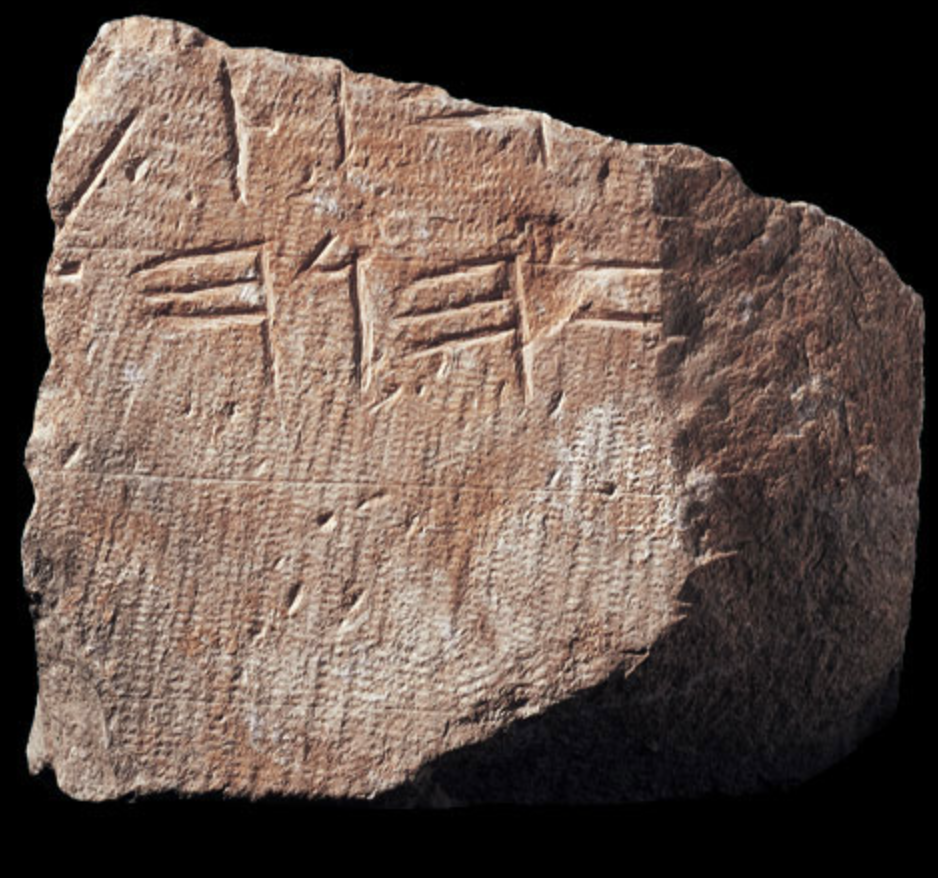
Image credit: Paleo-Hebrew inscription of YHWH carved in stone and found during the excavations of the Samaritan Temple on Mount Gerizim, courtesy of www.HolyLandPhotos.org.
part 1 of a series
How was it pronounced?
When on high the heaven had not been named,
Firm ground below had not been called by name.– Enuma Elish, Tablet 1, lines 1-2
It’s somewhat odd that so little commentary seems to exist concerning a distinguishing feature of homo sapiens sapiens: naming. After all, that was the only task YHWH assigned to Adam, no other labor required in the fructified garden to keep body and soul knit together. Moreover, no knowledge of good and evil is a necessary prerequisite in the endeavor of naming (“sparrow” carries no moral weight)—although, once the fruit was et, the original chore performed in happy ignorance became freighted with valences of a judgy sort. So you have friend and enemy, hero and traitor, saint and sinner—names that both describe and evaluate. And, ever ingenious in application of the illicitly acquired knowledge, your sort can heap moral scorn on purely descriptive nouns: dog becomes a disparaging description of Samaritans, Cretan comes to designate liars.
But wait. . . . Is naming really a distinguishing characteristic of the animal that tells itself it looks like a god? Maybe not. Dolphins, elephants and marmosets seem to label individuals with specific vocalizations (that would be, names). Japanese tits have distinct alarm calls for snakes, distinguishing them from other predators, anticipating the Prince of Botany in naming species. Chimps seem to identify specific foods with specific grunts—a behavior that may even be subject to social learning: when two captive groups are integrated, the acoustic structure of food grunts converge—namely, they come to agree on the names.
So what distinguishes your sort from other sorts, when it comes to naming, is the manic extreme to which you’ve taken chirps, squawks, squeels and grunts. Your sort invents names for everything, even things that don’t exist.
Which makes it something of a puzzle as to why translators of the English Bible (Hebrew and otherwise) resort to all manner of typological tricks when rendering the name of all names, the Divine Name. It’s not as if rendering names from mongrel tongues into the King’s English—even the gnarliest of them—exceed their skill. As sons of Adam and (a couple) daughters of Eve, the translation committees betray great facility in that pursuit. So you’ll find:
Misha, Elisha, Keziah and Uz,
Hodaiah, Tobiah, Seraiah and Buz.
Javan, Laban, Nahshon and Gad,
Jeremiah, Nehemiah, Hezekiah — David!
If any matter demands investigation, this would be among the most important. Upon it your eternal fate, real or imagined, may hinge.
The problem, insofar as it may be a problem to you (depending on level of interest), is that Hebrew is an abjad, a writing system lacking in vowels. Which makes a mess of everything. Imagine English (which is bad enough a writing system as it stands) as an abjad, and you come across the following word: rck. What might that mean? You might guess, rock, rick, rack. Great! Gold star and all that. But which part of speech might these be? Nouns, verbs? All could be either. Context usually gives the tell, as in Put your luggage on the rck versus Rck your brain. But not always. Imagine you’re reading a sacred text, in which you are given a divine command (probably among a long list of others), You must rck it (or, in proper abjad form, Y mst rck t). What might you be expected to do?
Which is the case with the name that is said to be above all: YHWH. Y-H-W-H is the English transliteration of the Hebrew letters (from right to left) yod, he, vav, and he, which you probably expect to look like יהוה. Fair enough, and ultimately it did. But block Hebrew/Aramaic didn’t become the standard until sometime between the 3rd and 1st centuries BCE. Before that the script most in use was what is now called paleo-Hebrew, and the Divine Name looked like 𐤉𐤄𐤅𐤄. Which is neither here nor there when it comes to figuring out three crucial issues: how it might have been pronounced, where it came from and, importantly, what it means.
The amount of human toil burned on the altar of answering the questions swarming what is formally known as the Tetragrammaton might make you despair of human effort altogether. It’s been going on for centuries, with progress being in inverse proportion to effort. The esteemed Bible scholar W.F. Albright quipped (in a judgy way), “The long debate over the original meaning of the name Yahwêh shows no sign of abating, and the most incredible etymologies are still advanced by otherwise serious scholars.”1 If only Eve had recognized the snake for what it was and given it a good slap across the chops rather than eating of the fruit it offered. . . .
Except, it might not have been a tetragrammaton originally. This goes to the question of how 𐤉𐤄𐤅𐤄 was pronounced, which goes to the insanity of having an abjad writing system. How much sweat-of-brow might have been spared if 𐤉𐤄𐤅𐤄 had waited to reveal his name until after the clever Greeks figured out how to add vowels to an alphabet! Oh, right, labor was the punishment for Eve not slapping the serpent across the chops. Of course—it’s your fault.
𐤉𐤄𐤅𐤄 appears 1,820 times in the Pentateuch, which most scholars (but not all)2 believe to have been compiled in the Persian period, maybe around 450–350 BCE, just before Alexander the Great knocked the Achaemenids off their throne. Its sources were likely a combination of written and oral (how much of each is debated), and the compilation may or may not have been authorized by the Persian overlords (also a matter of debate).3
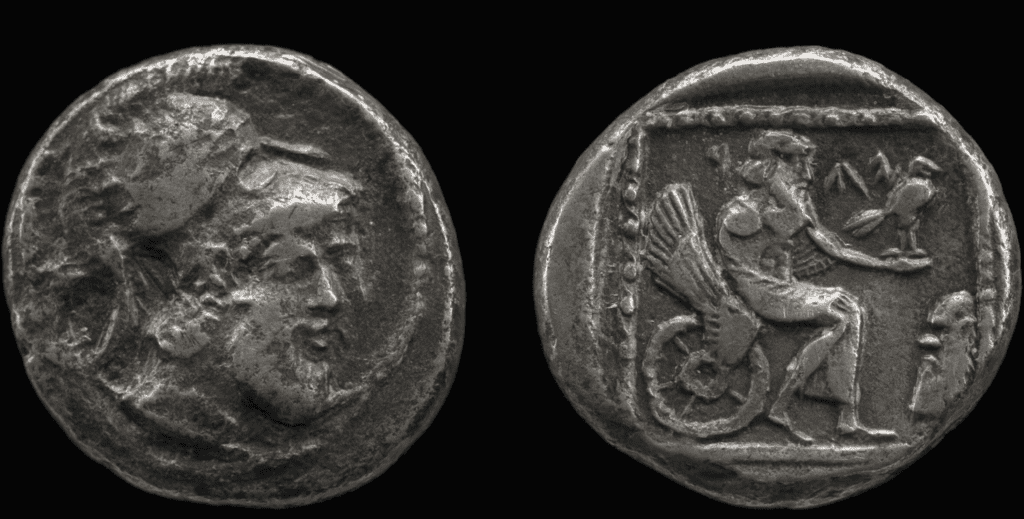
Silver drachma from the Persian period (ca. 380 BCE), now in the possession of the British Museum in London, first published in 1814. On the obverse (left) is the head of a man in a Corinthian helmet, perhaps a provincial governor. On the reverse (right) is a deity seated on a throne with wheels, perhaps an allusion to the vision of 𐤉𐤄𐤅𐤄 enthroned in Ezekiel 1 and 10. The Aramaic inscription reads either yhd, “Yehud” (the province Judah) or yhw, “Yahô” (the deity).4
Here’s a problem not often noticed: How has no explicit numerical value, but it does have an implicit one. To ask, How was 𐤉𐤄𐤅𐤄pronounced? might suggest that there was one way of pronouncing it. You would do better to ask, How was it pronounced when and where? Depending on who you believe in the endless skirmishes over dating, the earliest texts in the Pentateuch might be as early as the ninth or eighth centuries BCE.5 That would be a period archaeologists have named Iron Age IIA. But bits of it may be even older. Take, for example, the following duet sung by Deborah and the reluctant field commander Barak (part of a longer hymn known as “The Song of Deborah”):
𐤉𐤄𐤅𐤄, when you went out from Seir,
when you marched from the region of Edom,
the earth trembled,
also the heavens poured water,
the mountains quaked,
before 𐤉𐤄𐤅𐤄, the One of Sinai,
before 𐤉𐤄𐤅𐤄, the god of Israel.6
Why is it understood to be a song (vocalized) instead of just a poem (written)? Because Deborah says so: “… to 𐤉𐤄𐤅𐤄 I will sing / I will make melody to the 𐤉𐤄𐤅𐤄, for 𐤉𐤄𐤅𐤄 elohim of Israel.”7 Which hints at an ancient oral tradition. Which most scholars think it was, possibly reaching back into the very edge of the period archaeologists have named the Late Bronze Age IIB—the 1300–1200 BCE.8 Either way (Iron IIA or Late Bronze IIB), there were hundreds of years when the name 𐤉𐤄𐤅𐤄 was sung in verse before it was wrestled into written form. What might it have sounded like? Depends on how a singer might have seasoned the consonants with vowels: yahwah, yahwōh, yahua, yahoa, yāhôh? Maybe all of the above (so to speak), across time and place? Very possibly. Yahweh, so often used as to appear authoritative, is nothing more than a scholarly guess.9
Then there are the shortened forms of the Divine Name. These are found in non-divine names that dare to mix the sacred and profane, producing what are technically known as theophoric (“god bearing”) names. So you’ll find yirmĕyāhû (Jeremiah, “𐤉𐤄𐤅𐤄 appoints / establishes”), yĕša‘yāhû (Isaiah, “𐤉𐤄𐤅𐤄 is salvation”), yĕhônātān (Jonathan, “𐤉𐤄𐤅𐤄 has given”), using the shortened form ywh. Naming of this sort suggests to scholars that the short forms of the Name Above All were pronounced “Yāhû/Yāhô/Yāh.”10
An even-more-shortented form, yh, is in ample evidence, both in names (such as the extraordinary concoction ‘ēlîyāh, Elijah, “My ēl [god] is yāh” [𐤉𐤄]) and in what you likely take to be an exclamation of praise, Hallelujah, “Praise the Lord!”—which, if you’re an Evangelical, you repeat ad nauseum. Except, the Hebrew hallĕlû is not in the exclamatory mood but in the imperative (second person masculine plural, to be precise), thus a command, amounting to something like “Hey, you men, praise yāh, [dammit].” And then there are the intriguing pairings of the super sort version with other divine names, as in “Behold, ēl is my salvation . . . for my strength and song is 𐤉𐤄𐤅𐤄 yāh”11 and “You received gifts from people, even from those who rebel against the yāh elōhîm’s abiding there.”12
Discussion of the conundrugrammaton by Church Fathers indicate various pronunciations known in Patristic times: Iaoue, Iá, Iabé, Iaḗ, etc. A Greek translation of Leviticus at Qumran has Iaṓ, which in Greek is a two-syllable word, ia-o, corresponding to the Aramaic ya-hô.
All of this (and more) taken together has led some scholars to suggest that the Tetragrammaton was originally a trigrammaton, wherein the w in yhwh was not a consonant, but a consonant functioning as the vowel o, with the final h indicating the o is a long vowel. (Consonants masquerading as vowels are charmingly named mater lectionis “mothers of reading”—a clumsy attempt to fix the original sin of abjabs: their lack of vowels.) Anyway, that would give you the ancient pronunciation of the Divine Name: Yahô.13
So there you gô.
It’s often said that names were important in the ancient Near East, so much more so then than now as to be nearly incogitatable to moderns. To lack a name was to lack existence.
So you’ll read the story of randy Jacob (whose name means “heel,” because the tale says he was born gripping the heel of his twin brother, Esau, “rough”) who, with the help of two cousin-wives and two concubines, sired twelve sons, each of whom were given names pregnant with meaning:
Born of wife Leah (“weary”, whom Jacob didn’t think much of):
- Reuben (“See, a son!”) – “Because 𐤉𐤄𐤅𐤄 has looked on my affliction, surely now my husband will love me.”14
- Simeon (“heard” or “hearing”) – “Because 𐤉𐤄𐤅𐤄 has heard that I am hated, he has given me this son also.”15
- Levi (“joined” or “attached”) – “Now this time my husband will be joined to me, because I have borne him three sons.”16
- Judah (“praise”) – “I will praise 𐤉𐤄𐤅𐤄 this time.”17
- Issachar (“there is reward” or “wages”) “Elohim has given me my hire because I gave my maid to my husband.”18
- Zebulun (“honor” or “dwelling”) – “Elohim has endowed me with a good gift; now my husband will honor me, because I have borne him six sons.”19
Born of wife Rachel (“ewe,” Jacob’s favorite):
- Joseph (“he adds” or “may he add”) – “Elohim has taken away my reproach…. May 𐤉𐤄𐤅𐤄 add to me another son!”20
- Benjamin (“son of the right hand”) – “As her soul was departing, for she was dying, she named him Ben-oni [“son of my sorrow”], but his father called him Benjamin.”21
Born of concubine Bilhah (“timid,” Rachels maid):
- Dan (“he has judged” or “vindicated”) – “Elohim has judged me [Rachel] and has also heard my voice and given me a son.”22
- Naphtali (“my wrestling” or “my struggle”) – “With mighty wrestlings I [Rachel] have wrestled with my sister [Leah] and have prevailed.”23
Born of concubine Zilpah (“drought”, Leah’s maid):
- Gad (“Good fortune” or “luck”) – “And Leah said, ‘Good fortune!’”24
- Asher (“happy” or “blessed”) – “Happy am I [Leah]! For the women will call me happy.”25
Thus were born the tribes of Israel, into an unhappy family—Rachel and Leah caught in the maw of Jacob’s affections, the sons destined to war with their cousins (the descendents of Esau) to this very day. The saddest story ever told.
Jacob himself was famously re-named yiśrā’ēl (“May ēl contend” or “ēl has contended”) by some mystery-being who might have been El himself, as Jacob named the place where he wrestled with mystery-being Peniel (“face of El”). Improbably, Jacob prevailed over mystery-being, just as Rachel prevailed over Leah—but neither came away unscarred. In her competition to bear sons, Rachel died; Jacob, much to his surprise, escaped with only a bad hip.26
Jacob’s re-naming was the blessing he demanded of mystery-being whom he had in a choke hold. Importantly, mystery-being (who never coughed up his name) wouldn’t cough up the blessing until Jacob coughed up his name. Quite the social climber; Jacob went from being a heel to bearing the name of his people. You know, the chosen people, not everyone else.
The tale hints that Jacob had several daughters, busy as he was. In the Midrash, Rabbi Yehoshua taught that each of Jacob’s sons was born with a twin sister.27 However that may be, only one is named in the text: Dinah (“judged” or “vindicated”). The rest, unnamed, do not exist.
𐤉𐤄𐤅𐤄 was to suffer a similar fate.
- William Foxwell Albright, Yahweh and the Gods of Canaan: A Historical Analysis of Two Contrasting Faiths (Garden City, NY: Doubleday, 1968), 168. ↩︎
- For a Hellenistic date, see Niels Peter Lemche, “The Old Testament – a Hellenistic Book?” Scandinavian Journal of the Old Testament 7, no. 2 (1993), 163–93 and Russell E. Gmirkin, Berossus and Genesis, Manetho and Exodus: Hellenistic Histories and the Date of the Pentateuch, Library of Hebrew Bible/Old Testament Studies 433; Copenhagen International Series 15 (New York/London: T & T Clark, 2006). ↩︎
- James W. Watts, ed., Persia and Torah: The Theory of Imperial Authorization of the Pentateuch (Atlanta, GA: Society of Biblical Literature, 2001). ↩︎
- See Diana V. Edelman, “Tracking Observance of the Aniconic Tradition through Numismatics,” in Diana Vikander Edelman ed., The Triumph of Elohim (Grand Rapids, MI: Eerdmans, 1995), 185-225. ↩︎
- Konrad Schmid, “Textual, Historical, Sociological, and Ideological Cornerstones of the Formation of the Pentateuch,” in Jaeyoung Jeon ed., The Social Groups behind the Pentateuch (Atlanta, GA: SBL Press, 2021), 38. ↩︎
- Judg 5:4–5. Translation (excluding the paleo-Hebrew rendering of “YHWH”) by Mark S. Smith, “YHWH’s Original Character: Questions about an Unknown God,” in The Origins of Yahwism, Jürgen van Oorschot and Markus Witte eds. The Origins of Yahwism, Beihefte aur Zeitschrift für die alttestamentliche Wissenschaft 484 (Berlin/Boston: de Gruyter, 2017). ↩︎
- Judg 5:3. ↩︎
- See Serge Frolov, “How Old Is the Song of Deborah?” Journal for the Study of the Old Testament 36, no. 2 (2011), 163–84. Frolov disagrees with the consensus on early dating, arguing instead for a late pre-exilic, exilic or early post-exilic date, between c. 700 and c. 450 BCE. ↩︎
- Henry O. Thompson, “Yahweh (Deity),” in David Noel Freedman ed., The Anchor Bible Dictionary: Volume 6 Si–Z (Doubleday, 1992), 1011. ↩︎
- Thomas Römer, The Invention of God, Raymond Geuss trans. (Cambridge, MA: Harvard University Press, 2015), 27–28. ↩︎
- Isa 12:2. ↩︎
- Ps 68:18. ↩︎
- Römer, The Invention of God, 3-–32. ↩︎
- Gen 29:32. ↩︎
- Gen 29:33. ↩︎
- Gen 29:34. ↩︎
- Gen 29:35. ↩︎
- Gen 30:18. ↩︎
- Gen 30:20. ↩︎
- Gen 30:24. ↩︎
- Gen 35:18. ↩︎
- Gen 30:8. ↩︎
- Gen 30:8. ↩︎
- Gen 30:11. ↩︎
- Gen 30:13. ↩︎
- The translation of yiśrā’ēl given in David E. Fleming, “The name Yhwꜣ as a People: Reconsidering the Amorite Evidence,” in Annalisa Azzoni, Alexandra Kleinerman, Douglas A. Knight and David I. Owen eds., From Mari to Jerusalem and Back Assyriological and Biblical Studies in Honor of Jack Murad Sasson (University Park: Eisenbrauns/Penn State University Press, 2020), 418. ↩︎
- Bereshit Rabbah 82.8 on Gen 35:16: “He said to them: ‘What is [the meaning] of that which is written: “It was as she had difficulty in her childbirth…”?’ They said to him: ‘This is the way that one soothes the soul of the birthing mother. One says to her: Fear not,for you have borne a male offspring.’ He said to them: ‘That is not what your teacher Rabbi Yehoshua expounded. Rather, each and every tribe had a twin sister born with him, in accordance with what Abba Ḥalfoi ben Kureya said: An additional twin sister was born with Benjamin.’” See also Bereshit Rabbah 84.21 on Gen 37: 35: “Rabbi Yehuda says: The tribes married their sisters. That is what is written: ‘All his sons and all his daughters arose to console him.’” ↩︎