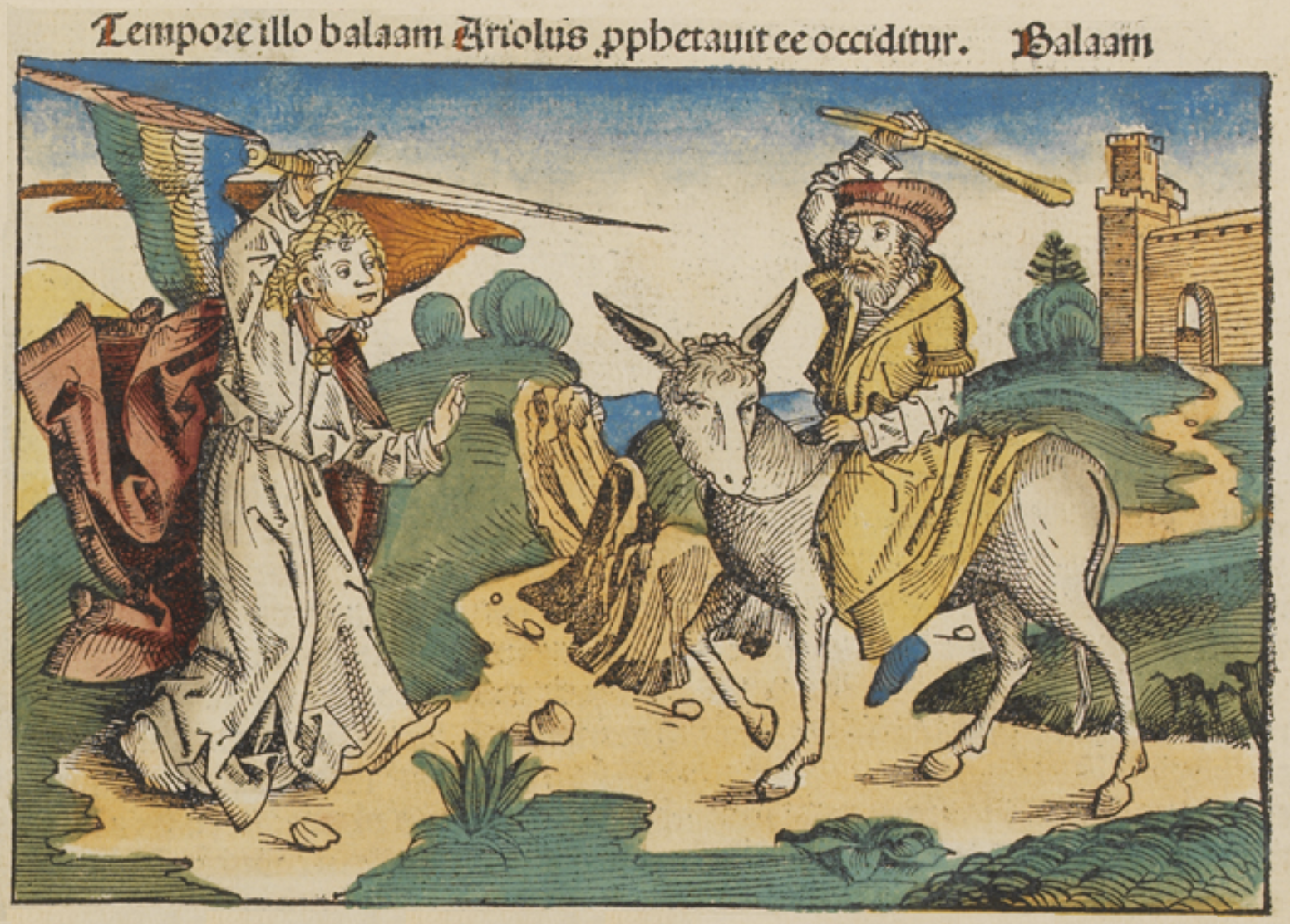
Image credit: Balaam, the Angel and the Ass; Woodcut from the Nuremberg Chronicle (1493)
part 3.2 of a series
Where did it come from (attributes)?
As flies to wanton boys are we to th’ gods;
They kill us for their sport.
— Shakespeare, King Lear, Act IV, Scene 1
Imagining a collection of discrete texts, written over centuries in multiple languages by authors with competing agendas and in entirely discrete social settings, as a unified text telling a coherent tale convening around a common theme makes about as much sense as a charcutier stuffing various animals into a meat grinder—maybe an ox, a goat, a dove, a pig (scratch that, definitely not pig), a ram—and extruding it into something’s intestines to produce a turd-shaped sausage.
You could do that. You could even sell it as “Covenant Sausage,” market it as the tastiest sausage in the history of ground animals—and find eager buyers! Maybe use the Agnus Dei symbol as your logo—you know, the penumbrated lamb cradling a cross, said utensil pressed into service as a battle standard?
An upside is that in producing your sausage, you need to kill a lot of animals, as was necessary in the case of the Sinai covenant. Your workers—the aliens in your factory, those who cut your wood and those who draw your water and those who crank your meat grinder—will doubtless be dashed with blood, as was the mixed multitude assembled at the foot of Mt. Horeb. So far so good.
Walther Eichrodt’s recipe for Covenant Sausage can be found in his three-volume cookbook, Theologie des Alten Testaments, which was quite the culinary innovation when it was first published in the 1930s. The prevailing taste in German biblical scholarship in those days ran toward two complimentary methodologies: history-of-religions (How was the religion of 𐤉𐤄𐤅𐤄’s chosen similar or dissimilar to non-chosen groups in the religious stew that was the ancient Near East?) and developmental (What are the earlier and later strata of the Pentateuchan layer cake, how did it evolve over time?).1
By no means a dope, Eichrodt did not reject out of hand the gains made by his German colleagues’ critical efforts,2 as did the American luddites in the Fundamentalist-Modernist controversy inflaming the United States around the same time—leading to the founding of such esteemed centers of higher learning as Westminster Theological Seminary,3 Bob Jones College4 and the Evangelical Theological College (which, apparently subject to evolution like the Pentateuch, molted into Dallas Theological Seminary).5 That fire burns like the LORD’s hot anger to this very day.
Eichrodt would count as one of Luther’s judges. He knew the languages, though it must be noted that he preferred the Greek version of the Old Writ to the Masoretic, the former deriving in his judgement from an older, “more reliable” Hebrew recension.6 (That would have set Luther fuming.) And he knew more than just the languages. He recognized a Deuteronomic tradition.7 He freely admitted that the texts were subjected to “explanatory additions,” making distinguishing pre- and post-exilic contributions something of a muddle.8 He could trace the various sources of the Exodus narrative.9 He had no problem speaking of “deutero-Isaiah.”10
What Eichrodt objected to in the historical-critical approach was that its practitioners seemed to think it answered all questions worth asking; the study of the Old Testament reduced to historical questions requiring only rational inquiry missed its essence, its “basic tendency and character.”11
By their very nature, the means of historical research extend only to the understanding of the conditional, the finite; in order to attain to the unconditional, to what is of absolute value, we are said to require a new disposition toward reality—in short, that of faith, which, as the organ for knowing the pneumatic world, is alone able to disclose the world of the Bible.12
Hard to argue with that, as assertions of faith sensed by an organ unobserved by anatomists and describing realities unseen are, by their very nature, unassailable. Trouble is, different pneumatic antennae quiver upon sensing different realities leading to different unassailable assertions.
If the historical-critical approach was one problem for Eichrodt—call it Skyla—the other, Chrydbis, was dogmatics. That was and is a theological method that looks to scripture as the source for establishing, ordering and defending Church (whichever Church) doctrines of both the sacred and profane variety. So in the Westminster Confession you’ll find the doctrine “Of God and of the Holy Trinity”13 alongside “Of the Civil Magistrate.”14 Clever divines can even find a way to hide the mundane within the sacred: the doctrine “Of the Communion of the Saints” takes care to endorse private property rights.15 And fair enough, because that’s how it was on Mt. Sinai, when 𐤉𐤄𐤅𐤄 delivered the law to Moses on two tablets, “the first four commandments containing our duty towards God, and the other six our duty to man.”16
Eichrodt would have none of that. “Covenant” was not a dogmatic concept but an epitomizing symbol for an actual historical process: a real God acting in the real life of an historical people to manifest a heretofore unheard of reality, the unique relationship of a people with God.17
And so Eichrodt charted a course between a strictly historicist approach and that of the “dogmatician,”18 which is where his methodological genius is to be found, if genius it is. He wanted to save Old Testament theology from being relegated to the realm of believing as distinct from knowing, from being kicked out of the club known as biblical scholarship.19 His solution was to apply a historical-critical approach to find the structural unity—the central theme—of the Old Testament from the testimony of the texts. The task he set himself was to “lay a cross section through the developed whole in order to demonstrate the inner structure of a religion in the mutual relation of its various contents.”20
And what he found, with the assistance of his handy organ, was that Israel’s association with 𐤉𐤄𐤅𐤄 was ever and always in the nature of a Bundesverhältnis (“covenant relationship”)—even where the keyword was most notable for its absence:
Hosea speaks twice of the berīt that Israel has broken (6.7; 8. I). Nevertheless it is worth noting that even for him the emphasis is not on the covenant concept, but that he makes use of other categories to describe the religious relationship. Amos, Isaiah and Micah all present it as an accepted fact that Israel’s relationship with Yahweh is based on the latter’s own free decision and inconceivable grace; it is only necessary to recall such passages as Amos 3.2, where the prophet is quite definitely expressing the proud conviction of the nation as a whole, when he speaks of Yahweh’s favour in choosing Israel above all other nations. But this makes it only the more astonishing that in precisely such passages as these, where to us the word ‘covenant’ suggests itself at once, the prophets never use it.21
Eichrodt was undeterred by such vacancies and so persisted in cranking out his Covenant Sausage, employing his novel exegetical technique. As all innovators discover, the downside of being a first mover is that, if successful, you’ll create a market. Which is to say you’ll create competitors. Sure enough, judges with different “dispositions toward reality” adopted Eichrodt’s thematic technique but with adjustments in ingredients. So you’ll find in the same cooler of your local Whole Faiths Market “Holiness Sausage,”22 “Communion Sausage,”23 “Kingdom Sausage,”24 “Promise Sausage,”25 “ “Gift Sausage,”26 and so on.
As for the dam in dam-hab-berît (“berît of blood”), Eichrodt allowed that it had a whiff of the primitive about it, suggesting an ancient mystery rite for renewing the life of the community by the comingling of the sticky fluid. And while such “covenant rituals,” so well known from many archaic cultures, may have had some effect on the events described in Exodus 24, Eichrodt insisted it didn’t alter the “essential character of Israel’s faith.” In the first place, primitive covenant rituals required constant renewal; 𐤉𐤄𐤅𐤄’s covenant with Israel was made once and for all. Secondly, the success of the primitive ritual lay in its proper enactment, whereas the Israelite ritual had a “moral basis and orientation.” And thirdly—the coup de grâce—primitive covenant rituals were impersonal transferrals of power lacking any notion of relationship. Israel’s rite, in sharp contrast, established “a personal communion between God and man,” one of “lordship—with its utterly personal character.”27
Eichrodt’s pneumatic organ, little excited at the mention of that vital substance (“the life of every creature”28), seems to have lacked a spidey sense.
The strange thing about the famous Sinai berît described in the Book of Exodus—well, it’s all strange from a modern perspective, unless you’re Catholic, which means you think you actually drink blood (which 𐤉𐤄𐤅𐤄 generally prohibited—unless the blood of enemies29). . . . Except, you probably don’t think you’re really doing that. Or maybe it’s divine blood that you’re consuming, escaping the prohibition because Yehoshua’s blood was sacrificial, thus shed for atonement, which is what 𐤉𐤄𐤅𐤄 said blood was for. . . .30 Protestants, of course, are much more refined than Catholics. They drink grape juice and eat tiny wafers, getting nowhere close to cannibalism or alcoholism—though Jesus did tell his disciples that the bread was his body and the wine was his blood, so maybe Catholics have a point. . . .
It all gets so complicated.
Anyway, the strange thing is the famous Sinai berît was not one but three. Not that anybody particularly notices, maybe because the first and the third lack the drama of the second. That’s the one where 𐤉𐤄𐤅𐤄 tells Moses to come up the mountain with Aaron, Aaron’s sons and the 70 elders to worship, which they all do. Why 70 elders? That’s 5.8 elders per tribe, which doesn’t make all that much sense—but who cares? Then Moses tells the people “all the words of 𐤉𐤄𐤅𐤄,” which he must have done from memory as he didn’t write them down until all the people agreed to do as told. Next comes the whole blood-ritual routine, which hardly bears repeating. But after that Moses felt the need to read the litany again, prompting the people to agree again.
As a narrative, it’s hardly Homer. But to be fair, Moses didn’t have vowels to work with, so maybe that explains it. The strange thing is that none of that was necessary. All the paperwork had been completed in chapter 19: 𐤉𐤄𐤅𐤄 told Moses the offer to convey to the people—keep my berît and you will be “a treasured possession out of all the peoples”31—and the people answered (apparently in unison; they must have had cue cards), “Everything that 𐤉𐤄𐤅𐤄 has spoken we will do.”32 Done and dusted. No threats, no need for hacking animals apart, just a reminder that 𐤉𐤄𐤅𐤄 had delivered the Israelites from Egypt. Maybe a little braggy on 𐤉𐤄𐤅𐤄’s part, as it had only been seven or eight weeks since the escape; you wouldn’t think the people needed reminding. But that’s splitting hairs.
Thus Sinai Berît 1.0 was generally positive; no threats, expressed or implied, were issued at its institution. You can almost imagine 𐤉𐤄𐤅𐤄 as a nice guy—and the berît as a “covenant.”
Except . . . the Israelites, who had only recently been informed of 𐤉𐤄𐤅𐤄’s existence, quickly learned what he was capable of. They saw 𐤉𐤄𐤅𐤄 turn the Nile to blood. They had escaped the slaughter of the firstborn only by following 𐤉𐤄𐤅𐤄’s requirement to smear their doorframes with the blood of slaughtered lambs. They watched as 𐤉𐤄𐤅𐤄 “tossed the Eyptians into the sea” to drown them one and all—despite the fact that the soldiers acknowledged 𐤉𐤄𐤅𐤄 and wanted to turn back. They had been warned that if (and only if) they obeyed 𐤉𐤄𐤅𐤄’s edicts would they escape the diseases inflicted upon the Egyptians. Worse still, they had learned just how close they could get to being on the receiving end of 𐤉𐤄𐤅𐤄’s ill temper. When they pointed out to Moses that they were starving to death, they were accused of uttering against 𐤉𐤄𐤅𐤄. When they mentioned that they were dying of thirst, they were accused of testing 𐤉𐤄𐤅𐤄. Which tells you something about your culture’s god: so transfixed was he by the reflection of his own face in the watery eyes of the Egyptians that he forgot his Treasured Possession’s need of food and water.
Thus, like the pretty Jewess chosen by the camp commandant to be his own, the Israelites meekly acceded to Sinai Berît 1.0, promising, “Everything 𐤉𐤄𐤅𐤄 has spoken we will do.”
The third berît is to be found in chapter 34. That’s after the second berît (chapter 24) and, more importantly, after the golden calf incident (chapter 32), which made such a mess of Sinai Berît 2.0 that a fresh start was required, including a whole new set of tablets. Sinai Berît 3.0 is typically considered a renewal of Sinai Berît 2.0, and you could think of it that way. Except, it’s entirely a one-sided affair, not at all like the 2.0 version. 𐤉𐤄𐤅𐤄 tells Moses to carve two stone tablets (again) and meet him alone on Mt. Sinai (again)—but this time very much alone. No Aaron and sons, no 70 elders in tow. Then 𐤉𐤄𐤅𐤄 bursts out in the weirdest poetic self encomium imaginable. Weird how, you might ask?
Weird point no. 1: 𐤉𐤄𐤅𐤄 passes before Moses’ face (which doesn’t turn out so well for Moses) and bellows, “𐤉𐤄𐤅𐤄, 𐤉𐤄𐤅𐤄. . . .” Why twice? Scribal error? Nope. The reduplication was standard practice in Old Testament divine invocations, whether of humans invoking a god or vice versa.33 𐤉𐤄𐤅𐤄 is cultically invoking himself, which the Faithful are likely to find objectionable, as their god is the recipient of cultic action, not the initiator—except when he is.
Weird point no. 2: Your English Bible will likely feed you something along the lines of “longsuffering” or “slow to anger” in the string of back-pats 𐤉𐤄𐤅𐤄 gave himself in Exodus 34:6–7. The attribute so contorted is actually “long-faced” or “two nostrils” (ʾerek ʾappayim). ʾAppayim is the dual of ʾap, “nostril,” which is usually associated with anger, like the flaring nostrils of an enraged bull. So, for example, you would read (if the Translators actually translated) that when 𐤉𐤄𐤅𐤄 realized that the Israelites were worshipping a metal calf, he was so pissed off he told Moses, “And now leave me alone, that my nose may flare against them and I may finish them off and make you into a great nation.”34 Moses had a similar reaction when he trundled down the mountain, tablets in hand, and witnessed the outrage himself: “As he approached to the camp and saw the calf and the dancers, then Moses’ nose flared, and he threw the tablets from his hands and smashed them at the mountain’s bottom.”35 Fortunately, the Translators, like their god, have the power to make rough places smooth for the fragile Faithful, who will read of no flaring nostrils or long faces, but rather of an anger slow in its manifestation. Which is somewhat at odds with the actual text: 𐤉𐤄𐤅𐤄’s long-facedness in Exodus 34:6 is a long way from longsuffering.
Weird point no. 3 (and the weirdest of all): Sinai Berît 3.0 required no consent of the people whatsoever. Which should be a clue as to what 𐤉𐤄𐤅𐤄’s “covenants” were all about. After beating himself up patting himself on the back in Exodus 34:6–7, 𐤉𐤄𐤅𐤄 takes the mask off. He drops all pretense that his berît was a mutual agreement and imposes it upon his Treasured Possession, without any need for their acquiescence. And in fact, “imposition” or “obligation” is a much better translation of berît than the one favored in your English bible.
Now, if you’re the sort of person happy with thinking of the kingdom as a mustard seed, you should have no problem thinking of the three beritot in Moses’ telling as a sandwich. The first and last are the buns encasing the meat in the middle, Sinai Berît 2.0. And where you have meat, you have blood.
Moses, it must be acknowledged, was a terrible writer. He had no sense of pace, no talent for building dramatic tension, which is why Numbers does not follow Exodus. Still, if he weren’t such a sanctimonious creep, you could almost feel sorry for him, furiously scribbling down even more of 𐤉𐤄𐤅𐤄’s insufferable pronouncements in that dud of a book wedged between Exodus and Numbers, Leviticus. Besides wrecking the plot, you’ll find all manner of crazy things in Leviticus, most of which didn’t bear recording and don’t bear reiterating. But then you’ll find a couple of things that you’ve known to be true all along, like childbirth is a nasty (you might say, “unclean”) business—making women a nasty business—and that the birth of a girl is an even nastier business than that of a son, requiring more denastification. Of course. How could it be otherwise?
Like 𐤉𐤄𐤅𐤄’s Sinai Berît 3.0, Leviticus is mostly 𐤉𐤄𐤅𐤄 jawing. Which, fine. Gods get to do what gods get to do. So if you really want to discern 𐤉𐤄𐤅𐤄’s attributes, you would do better skipping Leviticus altogether and having a look at Numbers. That’s where 𐤉𐤄𐤅𐤄 does some doing in addition to his endless jammering.
Having made a mess of things with Leviticus, you would think Moses might want to get back to the action. But no, he’s still lost the plot. He shovels you just over nine chapters of census-taking and tedious instructions until Numbers 10:11, when finally something actually happens: the Israelites depart the Sinai. But in those nine plus chapters of stultification there is a bit of a potential gem when it comes to 𐤉𐤄𐤅𐤄’s attributes. You see, 𐤉𐤄𐤅𐤄 was a jealous sort, which he considered such a positive attribute that he claimed “Jealous” as his name in Sinai Berît 3.0: “You shall worship no other god, because the Lord, whose name is Jealous, is a jealous God.”36 And that’s all there is to it, right? Well, maybe not.
In Numbers 5 𐤉𐤄𐤅𐤄 takes up the problem of unfaithful wives—or rather, wives accused of unfaithfulness by a husband overcome by a “spirit of jealousy.” 37 How to resolve an accusation of infidelity when witnesses are lacking? The solution was brilliant: trial by ordeal, constructed in such a way that the verdict amounted to an iudicium Dei, a “judgement by God.” In brief, the woman so accused is brought before the priest, who starts by messing up her hair, which is a clever way of making her look guilty before 𐤉𐤄𐤅𐤄 gets to render his judgement. Sort of like a booking photograph of someone the FBI has rousted in the middle of the night. Nice touch. Then there’s some business with an offering of grain that the jealous husband is supposed to bring, called “the grain offering of remembrance, which is the grain offering of jealousy”—whatever that means. But the important bit is the ordeal itself. The priest forces the woman to make an oath, which he writes down and then somehow dissolves into a concoction of holy water and dust from the floor of the tabernacle, the three ingredients together creating a brew called “bitter water,” which the priest forces the woman to drink. And that’s when 𐤉𐤄𐤅𐤄 gets to render his judgement. Per the oath, if the woman is innocent, nothing happens. But if she’s guilty, 𐤉𐤄𐤅𐤄 forces what for all the world looks like an abortion, followed by a uterine prolapse (“her womb shall discharge, her uterus drop”38). On top of that she’ll be shunned and rendered sterile, which for a woman in those days was a fate worse than death. Fair enough.
But what, you might ask, is the punishment meted out to a husband shown to be bearing false witness? 𐤉𐤄𐤅𐤄 doesn’t seem to have thought of that; no iudicium Dei is mentioned. Or, you might further ask, What about a wife accusing a husband of infidelity? Really? You have to ask?
The important point in all this is that 𐤉𐤄𐤅𐤄 recognizes that jealousy can be misplaced. Maybe no dark deed was done, maybe the husband is just a jealous jerk. Which might hint, however glancingly, at a rare moment of self awareness on 𐤉𐤄𐤅𐤄’s part. Could the god who names himself Jealous recognize that he too might be overcome by an errant spirit of jealousy? Is humility among his attributes?
However that may be, when the Israelites finally get back on the move, things go south pretty quickly. Imagine yourself a Latin American immigrant making your way to the Promised Land, that shining city on a hill to the north. To get there, you have to cross some god-forsaken desert—scratch that. Not god-forsaken—would that were the case. No, you’re in a desert with about a couple million other immigrants, and all of you have been forced by the lead coyote (Moses, by name) to plight your sorry troth to a snaggle-toothed deity with blood-red eyes (𐤉𐤄𐤅𐤄, by name). Or, that’s how you imagine the deity; only Moses is allowed to see his face.
It’s hot, it’s dry, everybody stinks. On the upside, the coyote has at least convinced the deity to provide your fare along the way: Melba toast. Now, there’s nothing wrong with Melba toast, particularly when topped with a nice Boursin cheese or smoked salmon. But that’s not the situation you find yourself in. No, it’s Melba toast for breakfast, Melba toast for lunch, and Melba toast for dinner. So you, all couple of million of you—your bodies practically screaming for some protein—complain to the coyote. It wasn’t great in Central America—there were gangs and drug cartels and all that—but at least you had decent food to eat. Would some meat be too much to ask?
Moses takes your complaint to 𐤉𐤄𐤅𐤄, not seeking a resolution, but to offer a complaint of his own: Why did 𐤉𐤄𐤅𐤄 saddle him with such an ornery lot? It’s too much to endure! Moses was 𐤉𐤄𐤅𐤄’s pet coyote; his belly-aching was fine. But you, the people? Not so much. 𐤉𐤄𐤅𐤄 tells Moses he’ll give you so much meat that it will be coming out your noses. No really, that’s what he said. And good to his word as ever, storm-god 𐤉𐤄𐤅𐤄 (after some weird and pointless interlude having to do with sending his spirit to rest upon 70 elders to ease Moses’ whiny burden) whipped up a wind that blew sea quails in to cover the camp. Lots of them, over three feet deep and a day’s journey on either side. Definitely enough to make you as sick of quail meat as you are of Melba toast. But then a lightbulb goes off in 𐤉𐤄𐤅𐤄’s addled brain: poison the meat! Before you can even choke the first bite down, 𐤉𐤄𐤅𐤄 sends a plague. Untold numbers die, giving the scene of the slaughter a charming name: Kibroth-hattaavah, “graves of craving.”39
And that’s pretty much how the whole journey went. Complaints, however legitimate (like lacking food and water) or (god forbid) challenges to Moses’ authority, trigger all manner of spastic attacks: plagues (a favorite), immolation (another favorite), poisonous snakes, suffocation by earthquake. . . . 𐤉𐤄𐤅𐤄’s murderous creativity knows no end, making the trek from Egypt to the Promised Land a bloody trail of tears.
The Book of Numbers is not entirely without levity; Moses threw in a talking donkey. And who doesn’t like talking donkeys?
By the time the Israelites had shuffled to the plains of Moab, they had already obliterated the Canaanites of the Negev under King Arad, two collections of Amorites (those of Hesbon and Jezer), and the people of Beshon, a land ruled by a king with an odd name, Og. King Og was so huge that he slept in an iron bed measuring 13.5 x 6 feet—not that his size worked much to his advantage. 𐤉𐤄𐤅𐤄’s Treasured Possession made short work of him and his:
The 𐤉𐤄𐤅𐤄 said to me [Moses], “Do not fear him, for I have handed him over to you, along with his people and his land. Do to him as you did to King Sihon of the Amorites, who reigned in Heshbon.” So 𐤉𐤄𐤅𐤄 our God also handed over to us King Og of Bashan and all his people. We struck him down. . . . And we utterly destroyed them, as we had done to King Sihon of Heshbon, in each city utterly destroying men, women, and children. But all the livestock and the plunder of the towns we kept as spoil for ourselves.40
If some sympathy had kindled within you for a people so ill used by a god who claimed them as his own, that should be enough to extinguish it. They gave as good as they got.
Aware of what had befallen those on the wrong side of the Treasured Possession divide, Balak, the king of Moab, was pissing his pants when he saw 𐤉𐤄𐤅𐤄’s horde camped in plain sight on the plains. What to do? Hire a consultant, of course. So Balak dispatches some of his elders as messengers to secure the services of a renowned seer, Balaam. The messengers offer Balaam a reasonable fee for what should be a simple task: come to Moab and curse the Israelites. Balak figured that would give him a chance of victory should the situation come to blows.
As a divine insider, Balaam was known to have a rolodex full of gods. He was from Pethor in northern Syria, so you would expect him to ring up El or Baal-Hadad, or maybe Dagan or Ishtar. So it’s something of a surprise that, when Balak’s messengers present their RFP to Balaam, he consults 𐤉𐤄𐤅𐤄. Or, sort of. It’s a little confusing. At first, Balaam says he’ll check with 𐤉𐤄𐤅𐤄, but it is Elohim who tells him not to take the job. But then Balaam tells the messengers that it was 𐤉𐤄𐤅𐤄 who told him to refuse the offer. Whoever it was, the messengers say, “Fine, suit yourself,” and return to tell Balak of their failed mission.
Increasingly desperate, Balak sends a second group of messengers, a larger and more distinguished group, with instructions to have Balaam name his price. As with the first group, Balaam says he would have to consult 𐤉𐤄𐤅𐤄, now specified as his Elohim. Once again, it is Elohim who appears to Balaam in the night, only this time Elohim tells Balaam to go with the messengers to Moab, but with the warning to do only what Elohim tells him to do. So Balaam saddles up his she-donkey and sets out for Moab.
Lost in Moses’ account is just how long all this back-and-forth would have taken. The distance from Pethor to the Moabite plains was about 580 km as the crow flies, but the caravan route they would have followed was somewhere between 700 and 800 km. Assuming a good clip of 30 km per day, the journey would take around 25 days. So that’s 50 days for the first group of emissaries to make the round trip, and another 50 for the second group, now with Balaam in tow on the return. So just to get the story going took three to four months. Think of it. That gave the Israelites, munching their Melba toast on the plains of Moab, plenty of time to draw up battle plans. But that was never going to happen. 𐤉𐤄𐤅𐤄 had told Moses not to bother the Moabites, as he had given the land to the descendants of Lot.41
Be that as it may, it seems that by the next morning, Elohim has changed his mind. He is now pissed at Balaam (nostrils flaring) for doing as he was told, prompting a messenger of 𐤉𐤄𐤅𐤄 to appear on the road in front of Balaam and his faithful steed, brandishing a sword to block their progress. Your English translation likely reads “the angel of the LORD,” which is something of a stretch. The Hebrew has “messenger (malʾakh) of Yahweh,” the same word used for the messengers (malʾākhîm) of Balak. Still, it had to be some sort of super-human being to be able to wink into view like that, so maybe angel isn’t all that much of a stretch.
Here’s where Moses makes an attempt at subtle irony. What are seers meant to do? See, of course. But Balaam doesn’t see the messenger; the she-donkey does the seeing and sensibly turns off the road into a field, prompting Balaam to give the donkey a good whack. That happens a couple more times until the donkey finally sags to the ground with Balaam still in the saddle. Furious, Balaam whacks the donkey again. You would be forgiven for imagining Balaam as Yosemite Sam urging his recalcitrant camel forward: “Giddy up! Come on camel, giddy up! Ya ya ya, camel, giddy up! Giddy. . . . When I say giddy up, I mean giddy up!” Whack.
Amusing as that undeniably is, Moses has more mirth up his sleeve. He swings for the hilarity fence:
Then 𐤉𐤄𐤅𐤄 made the donkey speak, and it asked Balaam, “What have I done to make you hit me three times?”
Balaam answered, “You’ve made a fool of me! If I had a sword in my hand, I’d kill you right now.”
The donkey said to Balaam, “I’m your own donkey. You’ve always ridden me. Have I ever done this to you before?”
“No,” he answered.42
A talking donkey! Who’d have thought?
As it turns out, 𐤉𐤄𐤅𐤄 is quite the prankster. He was the one who must have pulled the wool over the eyes of the seer, because he was the one who opens Balaam’s eyes allowing him to see the angel—who is now out of patience and pissed at Balaam for his animal abuse. Practically shaking with rage, 𐤉𐤄𐤅𐤄’s angel hisses at Balaam: the path he was following is “perverse” and furthermore, if the donkey hadn’t shown such horse sense, he, the angel, would have killed Balaam and left the donkey in peace. Having got that off his chest, the angel then repeats what Elohim had told Balaam several verses before: “Go with the men, but speak only what I tell you to speak.”43
Wait . . . what? What was that all about? Who knows? Lots of wind up, no pitch. Which is pretty much how the rest of the tale goes. Balaam makes it to Moab, where Balak repeatedly urges him to curse the Israelites, dragging the seer to three cultic high spots to catch sight of the Treasured Possession, the better to curse them. Curses, like radio waves, need a clear line of sight. Balaam, however, is as stubborn as his donkey. In the first of four oracular utterances, Balaam asks “How can I curse those whom El hasn’t cursed? How can I condemn those whom 𐤉𐤄𐤅𐤄 hasn’t condemned?”44 Hard to argue with that logic.
In his second oracular utterance, Balaam feels the need to school Balak in the nature of god: “El is not like people. He tells no lies. He is not like humans. He doesn’t change his mind.”45 But didn’t he change his mind about Balaam making the trip to Moab? Oh right, that wasn’t El, it was Elohim.
Which begs the question, Just how many gods are in play here? In his fourth oracular utterance, Balaam provides a hint by offering his bona fides:
This is the message of Balaam, son of Beor.
This is the message of the man whose eyesight is clear.
This is the message of the one who hears the words of El,
receives knowledge from Elyon,
has a vision from Shadday,
and falls into a trance with his eyes open.46
Now, imagine you’re in your senior year of college. You’ve completed all the coursework necessary for your major and have a semester to burn by taking courses you can easily ace. Maybe Home Economics, maybe Nautical Mechanics (i.e., a sailing course on the lake of a nearby state park). How about Comparative Religions? You opt for the latter, largely because Home Ec is for sissies and the sailing course is taught using sail-equipped surf boards known as Sunfish and the lake is notoriously windless. One of the texts for the Comparative Religions course is the Norton Anthology of Ancient Religious Inscriptions, and one inscription, attributed to 9th century BCE Syria, is exactly that as given in Balaam’s fourth oracle. How many gods would you say the text mentions?
But that’s not what happened. You take the Home Ec course after all just to prove you’re not afraid of being called a sissy, and the only place you read Balaam’s CV is in a book telling of three gods—but everyone tells you it tells of only one. Which is laughable on its face—even 𐤉𐤄𐤅𐤄 (who is notably absent from Balaam’s list) doesn’t buy that. When he’s about to slaughter all the firstborn of Egypt, human and animal, 𐤉𐤄𐤅𐤄 says, “I will severely punish all the gods of Egypt.”47 It’s true that, like the Assyrian kings he’s imitating, 𐤉𐤄𐤅𐤄 demands exclusive loyalty from his vassals. But that doesn’t suggest a lack of competing gods any more than there was a lack of competing suzerains. Much to the contrary, which is why 𐤉𐤄𐤅𐤄 says, “You shall have no other gods before me.”48
Except that’s not what happened either, because when you read your English translation of Balaam’s credentials, the Translators perform a miracle on a par with making a donkey talk; they make three gods bleed into one:
The oracle of Balaam son of Beor,
the oracle of the man whose eye is clear,
the oracle of one who hears the words of God
and knows the knowledge of the Most High,
who sees the vision of the Almighty,
who falls down but with eyes uncovered.
Will wonders never cease?
Getting back to the tale at hand, you would be forgiven for concluding that the whole tale of the seer, the donkey and the angel was entirely pointless, unnecessary and not all that amusing. After all, Balaam, having such insider knowledge of matters divine, could have told the first group of Balak’s messengers that the king was safe as houses. The renown seer must have been aware of 𐤉𐤄𐤅𐤄’s prohibition against molesting the Moabites. No need for the schlep to Moab, no need for talking donkeys and menacing angels. But no, Moses dropped that bit of information in a different version of the tale, one lacking Balaam and his donkey altogether.
In this version, the farce once begun has to be fully played out—only to end like a lead-balloon of a joke: “Then Balaam got up and went back home, and Balak also went on his way.”49
The angel in the Balaam story was not a one-off. 𐤉𐤄𐤅𐤄 made a habit of using agents to do his dirty work. Once he sent an angel to kill 185,000 Assyrian soldiers menacing Jerusalem.50 Another time he sent a messenger to kill 70,000 stiff-necked Israelites. That messenger, also called an angel, was about to go after Jerusalem, but 𐤉𐤄𐤅𐤄 relented and told his angel that enough was enough.51 Early days, 𐤉𐤄𐤅𐤄 seemed to have a thing about protecting the Holy City, but as the centuries passed he must have lost interest, because he let Titus sack the city in 70 CE.
The blood 𐤉𐤄𐤅𐤄 instructed Moses to instruct the Israelites to paint on their doorframes in Egypt was meant to ward off the most famous of 𐤉𐤄𐤅𐤄’s agents, the Destroyer.52 It amounted to an apotropaic trick: sensing the smeared blood, the Destroyer thought the necessary slaughter had been accomplished and moved on to the next target, which must have been exceptionally frustrating. 𐤉𐤄𐤅𐤄 reserved for himself the slaughter of the Egyptian firstborn and had a grand old time: “There was a loud cry in Egypt, for there was not a house without someone dead.”53 The Destroyer was left with the Israelites, who had been given a lucky charm. Though Moses doesn’t mention it, it’s a fair guess that the Destroyer slunk home that Halloween night with an empty sack. All the soon-to-be Treasured Possession were spared.
It’s not entirely unreasonable to surmise that Moses, impressed by the warding effectiveness of blood applied with a bunch of hyssop dipped in a basin of blood, thought it would do the same trick when he dipped a hyssop sprig54 into a vat of sacrificial blood and whisked it on the people in the Sinai Berît 2.0 ritual, endowing the sticky mess with a portentous significance: the dam-hab-berît. You would have to imagine Moses actually caring about his people, which finds only middling support in the texts. But if that was his thinking, it turned out to be a major miscalculation. 𐤉𐤄𐤅𐤄 had a nose for blood—a flaring nose. By blooding the people, Moses rendered the Israelites prey to 𐤉𐤄𐤅𐤄’s carnivorous predilections, ever in danger of being consumed.
Thus, 𐤉𐤄𐤅𐤄’s primary attribute with was that of predator.
Which made him unique among storm gods blowing around the region in those days. No record exists of a Baal choosing a people, instituting laws and cultic instructions, or commanding genocides of the ḥerem (“annihilation”) variety 𐤉𐤄𐤅𐤄 was so fond of. Baal-Hadad, the Ugaritic Baal of whom the most is known, had bigger fish to fry. He had to win his rivalry with Yam (the sea god), get a divine palace built and defeat Mot (the god of death). That’s not to say he was harmless; no god is. He was also in charge of maintaining fertility, mostly by sending rain through his heavenly window—but that could get out of hand. People needed rain but could generally do without floods, which happen.
As it turns out, not being chosen by a voracious storm god is a blessing. To be chosen is a curse.
𐤉𐤄𐤅𐤄’s lusty appetite for the blood of his Treasured Possession presented theologians with a conundrum that persists to this day. How could a good and just God perform such heinous acts? Various solutions have been proposed, none especially satisfactory.
The Israelites, wandering toward their promised land, had no time for theological ruminations. They were exiles, vulnerable in the land between Egypt and Canaan to dangers of both the divine and natural variety. The one thing that seemed to offer the best chance of survival was shed blood (preferably not their own) properly manipulated in ritual settings—two in particular:
Exodus 24 may in fact be read as the mirror image of the Pesaḥ. The blood ritual in Exodus 12 initiates Israel’s freedom; the blood ritual of Exodus 24 terminates it. Released from involuntary servitude to Pharaoh, Israel voluntarily enters Yahweh’s servitude.55
And maybe that’s the saddest story ever told.
Or maybe the saddest story ever told is that the Faithful, through the centuries and to this very day, contort themselves into ridiculous shapes desanguinating 𐤉𐤄𐤅𐤄, imagining him has his Treasured Possession wished him to be (merciful, slow to anger, all that) rather than as he actually was (a predator), and declare him True, Good and Beautiful. So you’ll read in the Westminster Confession:
There is but one only living and true God, who is infinite in being and perfection, a most pure spirit, invisible, without body, parts, or passions, immutable, immense, eternal, incomprehensible, almighty, most wise, most holy, most free, most absolute, working all things according to the counsel of his own immutable and most righteous will, for his own glory; most loving, gracious, merciful, long-suffering, abundant in goodness and truth, forgiving iniquity, transgression, and sin; the rewarder of them that diligently seek him; and withal most just and terrible in his judgments; hating all sin, and who will by no means clear the guilty.56
You’ll find that god in ancient texts, just not in those written in Hebrew.
Or maybe the saddest story ever told is simply the profound intuition expressed in narrative form in the various tales of the Bible, Old Berît and New: the inexorable law of There Will Be Blood. As there must be—life itself imposing an unspoken covenant between predator and prey: for something to live, something must die.
In which case, the fear of 𐤉𐤄𐤅𐤄 is indeed the beginning of knowledge.
EPILOGUE
Except for the most faithful of the Faithful, it’s generally agreed that El was the first god the people who were to become the Israelites knew. El was a genial sort of god. At Ugarit he was given the title lṭpn ʾil d pʾid, “the Gracious One, the Benevolent God.”57 He was the father (ʾab) of both men and gods, he healed diseases and blessed children, he sheltered his children under his wings in difficult times. A tick list of his attributes would include kind, caring, ageless, wise.58 When pictured, he sports a grey beard and sits on a throne, feet resting on a stool, his right hand raised in blessing.
When 𐤉𐤄𐤅𐤄 came along in the 9th century, El was generous enough to lend the storm god some of his attributes—and even his name—sanding some of the edges off 𐤉𐤄𐤅𐤄’s sharp personality. So you’ll read of El-like characteristics in descriptions of 𐤉𐤄𐤅𐤄. In the three times the Hebrew Bible mentions 𐤉𐤄𐤅𐤄’s age, he is invoked as El (twice) or Eloah (once).59 When 𐤉𐤄𐤅𐤄 is characterized as discerning or wise, he is called Elohim or Eloah.60 As creator, he is “El Elyon, maker of heaven and earth.”61
But as time wore on, things didn’t go quite to plan. 𐤉𐤄𐤅𐤄, so devastatingly effective against the Amorites, Canaanites, Hittites, Perizzites, Hivites, and Jebusites, was no match for the Assyrians, Babylonians and Persians. The god so familiar in stormy manifestations in the days of the Exodus (cloud, fire, smoke, earthquake, thunder) abandons such displays in the time of kings, barely able to raise his voice enough to be heard when Elijah seeks him out on the same mountain where the Treasured Possession were indentured:
As 𐤉𐤄𐤅𐤄 was passing by, a fierce wind tore mountains and shattered rocks ahead of 𐤉𐤄𐤅𐤄. But 𐤉𐤄𐤅𐤄 was not in the wind. After the wind came an earthquake. But 𐤉𐤄𐤅𐤄 wasn’t in the earthquake. After the earthquake there was a fire. But 𐤉𐤄𐤅𐤄 wasn’t in the fire. And after the fire there was a quiet, whispering voice. When Elijah heard it, he wrapped his face in his coat, went out, and stood at the entrance of the cave.
Then the voice said to him, “What are you doing here, Elijah?”62
As the tale of 𐤉𐤄𐤅𐤄 wears on, he recedes. Once the god of mighty acts—young, vigorous, embodied and with a lot to say—𐤉𐤄𐤅𐤄 becomes old, withdrawn, disembodied and silent.63 In Ezra-Nehemiah, he is most notable for his quiescence.
Human virtue and divine vigor are inversely proportional in the Tanakh. The Lord God never seemed more invincible than when conducting the endlessly complaining, recalcitrant, “stiff-necked” Israelites out of Egypt and through the desert to the land of Canaan. The generation of migrants whom we meet in Ezra and Nehemiah is by contrast the picture of piety. He himself, however, in their company, neither speaks nor acts. It is for this reason that this prelude to their story seems a coda to his. Back then, he seemed to be creating them as his people; now, they seem to be preserving him as their God.64
When the covenant is renewed after the exile, it is the people, not 𐤉𐤄𐤅𐤄, who initiate the binding oath; 𐤉𐤄𐤅𐤄 is nowhere to be found.65 And by the time the Book of Daniel reached its final form in the second century BCE, the god of Israel is envisioned in imagery strikingly reminiscent of El, with a beard white as pure wool, enthroned, presiding over his heavenly court.66
The way things usually go with gods and sons is for the son to overthrow the god and take his place. So the Greeks say Zeus castrated his father Cronos, the Babylonians say Ea killed his father Apsu, the Hurrians say Teshub dispatched Kumarbi. A story as old as time itself. The Hebrew Bible, read as a narrative whole, tells of a reversal: El killed 𐤉𐤄𐤅𐤄—and stole his name.
- Elmer Martens, “Eichrodt, Walther (1880–1978),” in Donald K. McKim ed., Historical Handbook of Major Biblical Interpreters (InterVarsity Press, 1998), 482. ↩︎
- Walther Eichrodt, Theology of the Old Testament, vol. 1, trans. J.A. Baker (Westminster Press, 1975), 30: “To say this is of course not to attempt to deny that this method accomplished an immense amount for the historical understanding of OT religion. It is impossible even to conceive of a historical picture that does not make use of its findings, and to that extent not one of us can help being in its debt.” ↩︎
- Founded in 1929 by fundamentalist Princeton Theological Seminary faculty, appalled at the liberal drift of the esteemed institution. ↩︎
- Founded in 1927 by its eponymous evangelist. ↩︎
- Founded in 1924 by the Bible teacher Lewis Sperry Chafer. ↩︎
- Walther Eichrodt, Ezekiel: A Commentary (Westminster Press, 1970), 12: “Thus in this, as in numerous other instances, the terser Septuagint text guides us to an older recension of the Hebrew text, more reliable than the Massoretic text.” ↩︎
- Eichrodt, Theology of the Old Testament, 5. ↩︎
- Eichrodt, Theology of the Old Testament, 73. ↩︎
- Eichrodt, Theology of the Old Testament, 36, n. 2. ↩︎
- Eichrodt, Theology of the Old Testament, 52. ↩︎
- Eichrodt, Theology of the Old Testament, 12. ↩︎
- Walther Eichrodt, “Does Old Testament Theology Still Have Independent Significance within Old Testament Scholarship?”, in Ollenburger, Martens and Hasel eds., The Flowering of Old Testament Theology: A Reader in Twentieth-Century Old Testament Theology, 1930–1990 (Eisenbrauns, 1992), 30–39. ↩︎
- The Westminster Standard, “The Westminster Confession of Faith,” Ch. II. ↩︎
- “Westminster Confession of Faith,” Ch. XXIII. ↩︎
- “Westminster Confession of Faith,” Ch. XXVI.3b: “Nor doth their communion one with another, as saints, take away or infringe the title or propriety which each man hath in his goods and possessions.” ↩︎
- “Westminster Confession of Faith,” Ch. XIX.11b. ↩︎
- Eichrodt, Theology of the Old Testament, 17–18: “For the concept of the covenant enshrines Israel’s most fundamental conviction, namely its sense of a unique relationship with God. The crucial point is not—as an all too na’ive criticism sometimes seems to think—the occurrence or absence of the Hebrew word berīt, but the fact that all the crucial statements of faith in the OT rest on the assumption, explicit or not, that a free act of God in history raised Israel to the unique dignity of the People of God, in whom his nature and purpose were to be made manifest. The actual term ‘covenant’ is, therefore, so to speak, only the code-word for a much more far-reaching certainty, which formed the very deepest layer of the foundations of Israel’s faith, and without which indeed Israel would not have been Israel at all. As epitomizing God’s action in history ‘covenant’ is not a dogmatic concept with the help of which a ‘corpus of doctrine’ can be evolved, but the typical description of a living process, which began at a particular time and place, and which was designed to make manifest a divine reality quite unique in the whole history of religion.” ↩︎
- Eichrodt, “Does Old Testament Theology Still Have Independent Significance,” 32. ↩︎
- Eichrodt, “Does Old Testament Theology Still Have Independent Significance,” 31–32. ↩︎
- Eichrodt, “Does Old Testament Theology Still Have Independent Significance,” 33. ↩︎
- Eichrodt, Theology of the Old Testament, 5. Emphasis added. ↩︎
- Ernst Sellin, Theologie des Alten Testaments (Quelle & Meyer, 1933; 2nd ed., 1936). ↩︎
- Theodorus Christiaan Vriezen, An Outline of Old Testament Theology, trans. S. Neuijen (Blackwell, 1958). ↩︎
- Günter Klein, “The Biblical Understanding of ‘The Kingdom of God,’” Interpretation 26 (1972): 387–418. ↩︎
- Walter C. Kaiser Jr., Toward an Old Testament Theology (Grand Rapids: Zondervan, 1978). ↩︎
- Bruce K. Waltke, with Charles Yu, An Old Testament Theology: An Exegetical, Canonical, and Thematic Approach (Grand Rapids: Zondervan, 2007). ↩︎
- Eichrodt, Theology of the Old Testament, 43–44. ↩︎
- Lev. 17:14. ↩︎
- Prohibited: Deut 12:23; allowed Num 23:24. ↩︎
- Lev 17:11. ↩︎
- Exod 19:5. ↩︎
- Exod 19:8. ↩︎
- William H.C. Propp, Exodus 19–40: A New Translation with Introduction and Commentary (Doubleday, 2006), 609–10. ↩︎
- Exod 32:10. Translation by Propp, Exodus 19–40, 539. ↩︎
- Exod 32:19. Translation by Propp, Exodus 19–40, 540. ↩︎
- Exod. 34:14. ↩︎
- Num 5:14. ↩︎
- Num 5:27. ↩︎
- Num 11:34. ↩︎
- Deut 3:2–3, 6–7. ↩︎
- Deut 2:9. ↩︎
- Num 22:28–30. ↩︎
- Num 22:35. ↩︎
- Num 23:8. ↩︎
- Num 23:19. ↩︎
- Num 24:15–16. ↩︎
- Exod 12:12. ↩︎
- Exod 20:3. ↩︎
- Num 24:25. ↩︎
- 2 Kgs 19:35. ↩︎
- 2 Sam 24:15-16. ↩︎
- For construing the Destroyer as a personal agent rather than the abstract “destruction,” see William H.C. Propp, Exodus 1–18, (Doubleday, 1999), 408–09. ↩︎
- Exod 12:30. ↩︎
- The means of application, missing in the Exodus account, are given in Hebrews 9:19. ↩︎
- Propp, Exodus 19–40, 309. ↩︎
- “The Westminster Confession of Faith,” ch. II, “Of God, and of the Holy Trinity,” § 1. ↩︎
- Theodore J. Lewis, The Origin and Character of God: Ancient Israelite Religion through the Lens of Divinity (New York: Oxford University Press, 2020), 79. ↩︎
- Asli Kahraman Çinar, “The God El and His Attributes at Ugarit,” Oannes 7 no. 2 (2025), 393–95. ↩︎
- ohn Day, Yahweh and the Gods and Goddesses of Canaan, Journal for the Study of the Old Testament Supplement Series 265 (Sheffield Academic Press, 2000), 18. ↩︎
- Day, Yahweh and the Gods and Goddesses of Canaan, 19. ↩︎
- Gen 14:17. ↩︎
- 1 Kgs 19:11–13. ↩︎
- For excellent treatments of YHWH’s remoteness in the later texts, see Richard Elliott Friedman, The Disappearance of God: A Divine Mystery (Little, Brown and Company, 1995) and Mark McEntire, Portraits of a Mature God: Choices in Old Testament Theology (Fortress Press, 2013). ↩︎
- Jack Miles, God: A Biography (Vintage Books, 1995), chap. 12, § “Scroll: ‘We Make This Pledge in Writing.’” ↩︎
- Neh 10:28–29. ↩︎
- Dan 7:9–10. ↩︎